We keep hearing that “only six Americans were killed.” It is meant as reassurance — a way of saying this new war with Iran is under control, measured, responsible. But no phrase that includes the words only and killed in the same breath is morally sane.
Six is not a statistic. It is six families whose world just ended, six stories cut off mid‑sentence, six ripples of grief that will move quietly through towns and units and church pews for decades. And while we fixate on that small, neat number, the wider toll in Iran and Israel is flattened into even blunter abstractions — “hundreds of civilians,” “collateral damage,” “secondary effects.” Lives with names and faces are repackaged as acceptable costs.
The explanations we are given are just as abstract. We are told that the United States and Israel are “sending a message,” “re‑establishing deterrence,” “degrading capabilities.” Those phrases might hold elements of truth, but they are so vague that they never quite answer the only question that matters: what exactly is worth killing for here, and how will we know when we have killed enough?
Those of us who’ve been here before on these pages will remember what we said about Brian Thompson — that belief in a just cause does not make an act just, and that Aquinas himself drew a hard line: authority is only legitimate when exercised within the law. What we recoiled at in a parking lot in New York, we should recoil at now. A preemptive strike against a nation actively engaged in negotiations is not deterrence exercised by legitimate authority. It is the state doing precisely what we condemned in that gunman. Augustine and Aquinas did not give us just war theory as a permission slip. They gave it to us as a fence. And this war cleared that fence before the ink was dry on the negotiating table.
Without a clear, limited end in view, language becomes a shield. Numbers become a way to manage public anxiety rather than to tell the truth. We drift into exactly the partiality scripture condemns: counting some image‑bearers as fully human and others as background, comforting ourselves that the whole thing is unfortunate but necessary.
House of Heroes — Valley of the Dying Sun · In the Valley of the Dying Sun (2011)
That is where Valley of the Dying Sun becomes more than a song. It refuses the comfort of distance and statistics and forces us down to the level where war is always actually lived: one soldier, one enemy, one moment in the valley. It shows us how easily the man in front of us becomes a number in a briefing — and how costly, and necessary, it is to see him again as a mirror, not a monster.
House of Heroes’ record offers two stories at once — one told outright, and one alluded to. On the surface, it is the story of a soldier walking into violence, wrestling with fear, obedience, and the face of the enemy. But beneath that narrative runs the older, deeper story of Jacob: the man who walked a crooked path, entered a dark valley, wrestled with God, was wounded, and finally reconciled with the brother he feared.
In the valley of the dying sun
I walk a crooked path alone
I came across the shadow of a man
With an angel’s breath
“Oh, boy,” he said to me
“I see your future
Though you long for peace
The sword is your father.”
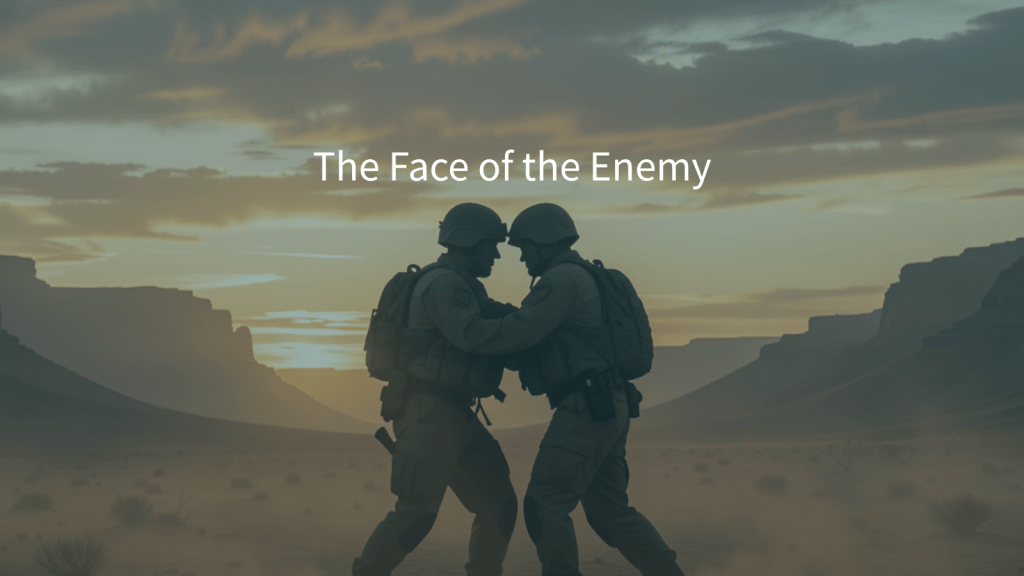
The song traces the same arc as Genesis 25–33: the crooked path, the valley at night, the wrestle and the wound, and the reconciliation that reveals the face of God. The video’s imagery — two soldiers grappling in a barren valley at dusk — becomes a modern parable of that ancient story. It shows us that the real enemy is not the one in front of us, but the fear and self‑protection within us.
When the song speaks of a “shadow of a man with an angel’s breath,” it echoes the mystery of Genesis 32. Jacob wrestled a man who felt human and divine at the same time. The soldier in the song does too. The enemy becomes the place where God confronts him. The breath of the angel is the breath of conviction — the breath that reveals God is not his enemy, and therefore the man in front of him isn’t either.
The Chorus Is a Prayer
“I’m thinking of You” is spoken to God as the soldier confesses what he’s done and what he fears. He thinks of God when he kills a good man — someone just like him, acting out of orders and survival, not hatred. He thinks of God when he holds his girl and imagines her grief if he were the one to die.
“Hatred is not necessary for soldiers to fight effectively and is often harmful to them. He notes that while some combatants do develop hatred, it is far from universal and often emerges after traumatic losses, not as the baseline state of mind.”
Lt. Col. Pete Kilner
This is also the place to tell the truth about war. We don’t hate the people who attack us — at least I never did, and countless soldiers across generations have said the same. Hatred isn’t what drives you in those moments; training, fear, instinct, and the will to survive do. The man in front of you isn’t a monster. He’s a good man caught in the same machinery, following orders he didn’t write, trying to stay alive just like you. That’s why the chorus lands as a prayer: “I’m thinking of You” becomes a confession spoken to God about the tragedy of two good men forced into violence neither chose.
Bathed in the powder of a thousand guns
I am the king of sorrows
Watered by the tears of the innocent ones
The river grows
It moves
It swells
I never fired a weapon in combat, but I lived under rocket attacks and controlled aircraft that took lives. I was part of a machine that dealt death, even if I wasn’t the one pulling the trigger. And I did it for empire, not justice…
That weighs on me…
What do you call it when a nation projects power to protect its interests and names that protection righteousness? I’ve been trying to find a better word than empire for twenty years. I haven’t found one.
The river of sorrow in the song — the tears of the innocent, the swelling grief — feels like the river that runs through anyone who has lived in the shadow of war, whether they fought directly or simply stood close enough to feel its heat.
The Wrestle
This is the moment when a man is stripped of every illusion of control. And “tonight will be my ending or tonight my new beginning” is the truth every one of us faces when we finally stop running. This isn’t a crafted salvation prayer. This is the moment when God becomes real — terrifyingly real — and the old self either must die, so the new man can be reborn.
Before he ever wrestled with God, Jacob walked a crooked path of his own — hurting others, running from consequences, living with fear he couldn’t shake. His valley came when all of it finally caught up to him. And like the soldier in this song, he had to face the truth of who he’d become before he could be reborn.
And then comes the line that breaks everything open: “And for the first time I could see…that God was not my enemy.”
This is the revelation Jacob had in the dirt beside the Jabbok, and it’s the revelation every believer must face. Scripture is blunt — while we were still sinners, we were enemies of God. Not neutral. Not misguided. Enemies. And yet God refused to take the posture toward us that we so easily take toward others. How can we hate anyone with this knowledge? How arrogant is it to claim a right to hostility that God Himself has laid down?
Enemy‑Love Is Not Soft
This is where the video refuses to let us settle for a soft definition of enemy‑love. This isn’t about being polite to a difficult coworker — that’s neighbor‑love. Jesus calls us to something far more costly. Enemy‑love is directed at those who openly oppose us, who threaten what we cherish, who would tear down our culture or our faith. Those are the people God loved when we were His enemies.
In the final scene, when the soldier tries to breathe life back into the man who tried to kill him, we see the truth we’ve forgotten: God has never taken a posture of hatred toward His enemies. How dare we claim a right to hate that which God Himself refuses? Enemy‑love is the unfinished project of the church — and the place where our witness will rise or fall.
What About Iran?
Some will say that enemy‑love doesn’t apply here because Iran is an evil regime. But if we’re going to invoke Romans 13, we have to apply it the way Paul wrote it. He wasn’t talking about a righteous government; he was talking about Nero’s Rome — a state far more brutal, pagan, and unjust than Iran is today.
If Romans 13 applies to us, it applies to them. And if it doesn’t apply to them, then we can’t use it as a shield for ourselves. Scripture doesn’t tell us which nations are good; it tells us what governments are for, and it warns us that every government — ours included — can drift from its calling.
That means we can’t decide who counts as an enemy based on the moral quality of their regime. We have to decide based on the moral clarity of the gospel. If God is not our enemy, then we cannot decide who our enemies are based on national allegiance or political narratives. We have to decide based on the cross.
We all walk our own crooked paths, and sooner or later we enter a valley where the old self can’t keep going. Most of us meet our enemies there — sometimes in front of us, more often inside us.
But the God who met Jacob in the dark still meets us in ours. He wounds what must die and names what must live. And when we finally see that He is not our enemy, something in us breaks open.
If that’s where you find yourself — caught between fear and surrender — then let this be your Jabbok. Lay down the hostility you’ve carried, toward God or toward others. Let Him name you again. And step into the costly, beautiful work of loving even those who stand against you.
That is where the new beginning always starts.




Leave a reply to R.T. Hadley Cancel reply