
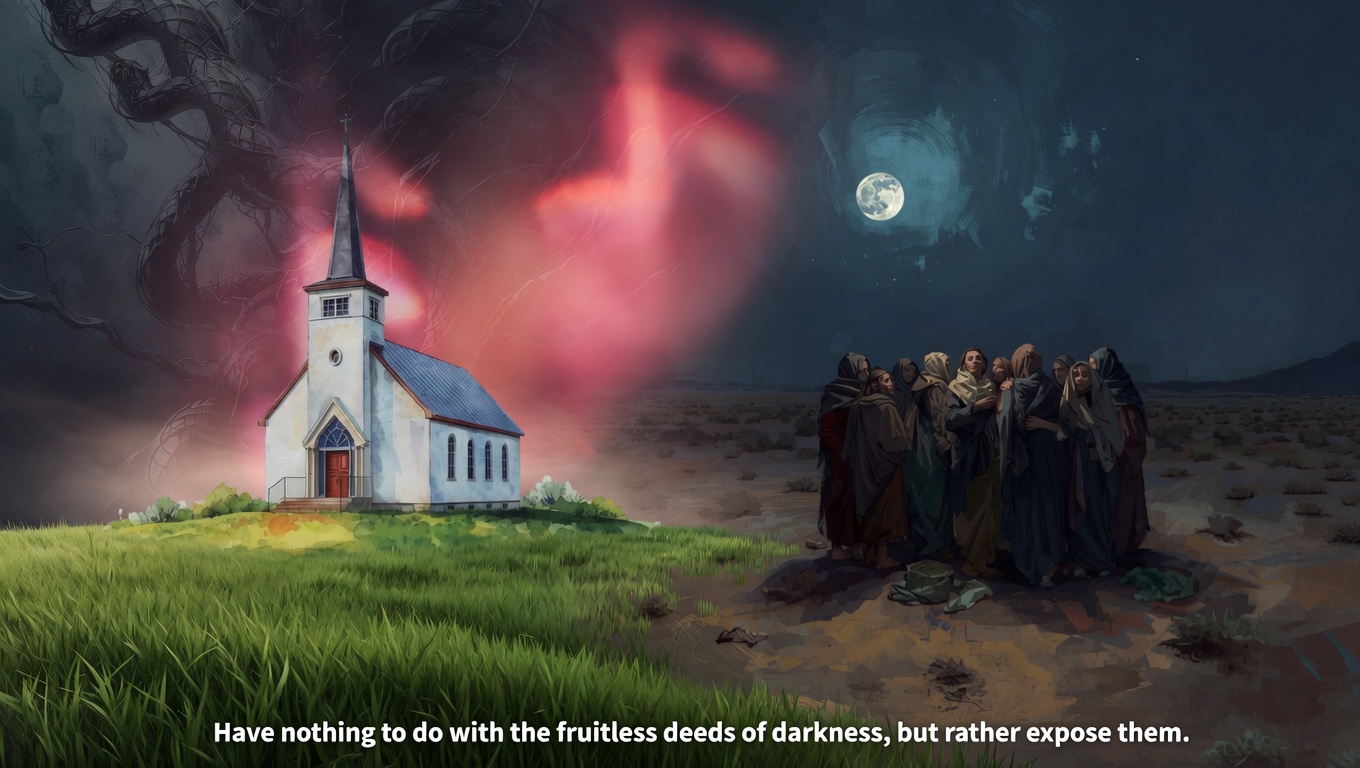
There was a pall over the Sportpalast that November morning in 1933, though twenty thousand people felt nothing of it. They felt something else entirely: the electric certainty of a movement, a second reformation being born in real time, the anthem of the nation rising in what had been a house of faith. I have sat with that image long enough to understand how they got there.
The catastrophe did not arrive as catastrophe. It came slowly; in ways history books often flatten. Most of the crowd shared in frenzied enthusiasm. A cross-shaped absence stood in a room full of crosses. The Jesus being proclaimed from that stage was a fearless fighter and leader, stripped of Gethsemane, stripped of his Jewishness, stripped of the enemy-love the earliest communities understood as the first mark of the Way. The crowd did not notice the pall, because the pall was the Spirit’s grief, and the Spirit grieves quietly.

Years later, by small steps that never seemed dangerous, the lie took hold and was even embraced. Baptism Sunday soon came, and the faithful would witness a child lowered into a font supported by a base with a stormtrooper carved into it. Many would believe that they were faithful to Jesus, but scripture is clear that narrow is the road.
There was a remnant.
Then, as…
There always is.
They were not comfortable people, nor safe ones. They signed their names to the declaration at Barmen that said the church’s allegiance belonged to God and not to a Führer, and they knew what it would cost to say it.
Some of them went to prison. Dietrich Bonhoeffer went to the gallows seventeen days before liberation. The remnant is never the majority. It is never celebrated in the moment. It is simply the people who cannot make peace with the pall.
Being a part of the remnant always costs, though the costs are not always equal.
I see it today inside the church, and in our communities: the same pall, the same enthusiasm, the same cross-shaped absence dressed in the moment’s language. There is nothing new under the sun. I recognize how arrogant that can sound, as though seeing clearly were proof of moral superiority. It is not. My position is not a product of superior vision. It results from seeking Jesus, of becoming, slowly and imperfectly, a person of the Way. The Way offers a lens that clarifies what you are looking at.
Many churches place the American flag prominently on the platform beside the cross, as though they belong to the same story. I have watched video of men proudly wheeling a child dressed as the president down a church aisle; the baby wrapped in flags and campaign slogans; the congregation rising around them. The mood was celebratory. The people believed they were doing something faithful.
That is the thing about the pall. It is only visible from the edges.
I recognize the internet is not real life. But more and more, it has become the voice of the nation, the place where what people actually believe surfaces without the friction of Sunday morning decorum. What a person posts without embarrassment tells you what they have been formed to see as normal.
I have seen the images. Christians and pastors sharing pictures of Jesus with his hand extended uniquely over Donald Trump. Anointing a specific man for a specific purpose. The imagery is deliberate. The theology underneath it is older than we want to admit.
The most disturbing image, though:
The president edited and posted it himself: his own face in the posture of Christ the healer, hands glowing over a man representing America, warrior imagery filling the background behind him.

He altered it deliberately. He published it as his own. When the protest came, he did not repent of the image. He offered a lie so casual it was almost gentle—he had thought it was himself as a Red Cross doctor.
The crowd that defended it believed that they were being faithful. That is the sentence I cannot move past. Not that a politician made a self-serving image. That is old and unsurprising. What stings is that the church, or enough of it, rose to defend it without sensing the pall.
C.S. Lewis argued, and many evangelicals have rightly repeated him, that moral truth is not invented. It is already laid into the framework of the universe and is as sure as gravity. The law we appeal to when we say something is unfair or wrong is a law we did not write and cannot unmake. It bends for no one.
I want to take that argument seriously, more seriously perhaps than it is sometimes taken by those who wield it. Because that argument means a great deal to our Christian formation.
Enemy-love is in that law. It is not a Christian invention. It comes from a God who loved each of us while we were still his enemies. The early church placed it at the very threshold of its life together. They saw this and Spirit led generosity as the marks of a Christian.
The accommodation we are watching is not a conservative position. It is the oldest form of relativism: the belief that truth bends for us, for our nation, for our moment, for our man. Lewis spent his life arguing against exactly this.
The first Christians called it the Way of Death.
There is one line in the Didache (The Teaching) that speaks to this formation. In its description of the Way of Death, the path the community is instructed to flee, it names among the markers of that road those who love lies.
Not those who tell lies.
Those who love them.
These were people for whom truth carried a specific price. Confession of Jesus as Lord in a world that required confession of Caesar was not a preference. It was a capital claim that led to torture and physical death. They knew what it cost to refuse the empire’s lies about peace and power and who mattered. They paid that cost in prison sentences and in blood.
From inside that cost they looked at the Way of Death and saw that loving lies was its symptom and its engine. The comfortable lie. The lie that makes the present moment more livable.
The lie that lets the crowd keep rising, lets the flag stay beside the cross, lets the glowing hands go unquestioned, lets a Red Cross doctor stand in for what everyone could plainly see.
The love of lies is not first an intellectual failure. It is a spiritual posture. It is the decision, made slowly and then all at once, that the truth has become too costly and the lie is more livable. A community that makes that decision loses something it cannot easily recover: the capacity to feel the pall, to sense the cross-shaped absence.
“But I say to you who hear, Love your enemies, do good to those who hate you, bless those who curse you, pray for those who abuse you. To one who strikes you on the cheek, offer the other also, and from one who takes away your cloak do not withhold your tunic either."
Luke 6:27-29
The Deutsche Christen (German Christian) did not begin as people who loved lies. They began as people who found one lie survivable. Then another. Then the lie became the architecture.
The early Church lived by the two greatest commandments. That is how it grew under persecution.
If we are to be a remnant, then we must do as they did:
“You shall not hate any man; but some you shall reprove, and concerning some you shall pray, and some you shall love more than your own life.”
Didache Chapter 2

Leave a Reply