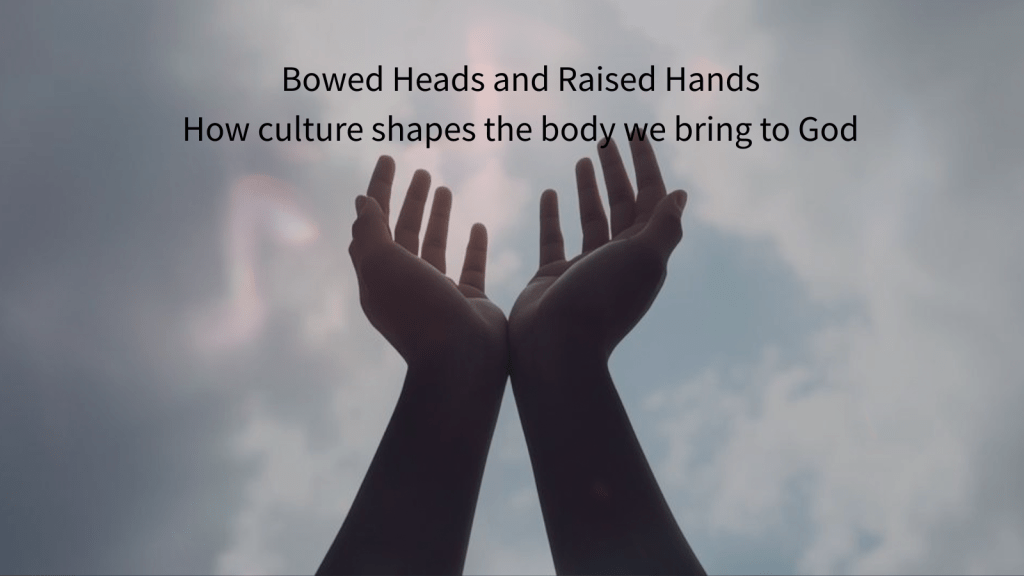
I’ve bowed my head thousands of times when I pray without asking why.
“After Jesus said this, he looked toward heaven and prayed…”
John 17:1
We tell people to bow their heads.
It is the most natural thing in our western world, so natural we do not notice we are doing it. The worship leader transitions to prayer, voices drop, and ten thousand evangelical heads tilt forward in unison. Eyes closed. Shoulders inward. The posture of humility, we assume, or maybe just the posture of prayer, because it is the only one we have ever known.
But Jesus looked up.
Not as an exception. Not as a dramatic gesture unique to the High Priestly Prayer. The Gospels show him looking toward heaven repeatedly, at the tomb of Lazarus, before feeding the five thousand, in the synagogue. This was simply how he prayed. It was how Jewish people prayed. Standing, eyes open or lifted, body oriented toward the God who is up there and also right here.
The ancient posture was not collapse but address, the stance of someone speaking to a person, not performing contrition before a throne. Come boldly to the throne of grace.
“Let us then with confidence draw near to the throne of grace, that we may receive mercy and find grace to help in time of need.”
Hebrews 4:16
This “boldness” stands in contrast to the “collapse” of medieval penitence, emphasizing that our “resurrection posture” reflects our status in Christ.
So where did the bowed head come from?
Not from Scripture. It emerged gradually through medieval Western Christianity, where penitential theology shaped the body as much as the soul. To approach God was to approach a sovereign, and sovereigns demanded deference. The bow became the instinctive grammar of prayer: humble, inward, eyes averted. By the time the Reformation came and went, and Protestant private devotion solidified into habit, the bowed head had become so standard it felt scriptural. It felt natural. It felt like the only faithful option.
Of course, the point is not that bowing or kneeling is unbiblical; Scripture is rich with figures who brought their bodies low, from Solomon’s dedication of the temple (1 Kings 8:54) and Daniel’s consistent devotion (Daniel 6:10) to Jesus’ own agony in Gethsemane (Luke 22:41). The tension I am highlighting lies not in the act itself—which is always appropriate in a spirit of humility—but in the singular standardization that has turned a profound, diverse expression of the soul into a cultural default.
Scripture rarely offers a rigid formula for how we are to walk out our faith or orient our bodies; instead, it provides a landscape of responses to the Divine. When we allow tradition to effectively plan our spiritual instincts, we risk flattening that biblical richness into a predictable script, trading the unsettling freedom of the Spirit for the safety of a habit we never actually chose.
We are not the whole Church, only a part of it, many practice Prayer in other ways.
Meanwhile, Eastern Orthodox Christians were doing something different. Their liturgical vocabulary was and remains far richer: full prostrations with forehead to the floor, standing upright in resurrection posture, the ancient orans (Latin for one who is praying or pleading) position with arms raised and open. The Council of Nicaea in 325 actually prohibited kneeling on Sundays, because standing was the body’s confession that Christ had risen and death had lost. Posture carried theology. The body was not a neutral container for the soul’s private transactions with God. It was a participant.
Here is the irony Western evangelicalism has mostly missed: we stand to worship and bow to pray, which is almost precisely the reverse of the biblical pattern. In Scripture, worship flattens people. Isaiah falls as though dead. The elders in Revelation cast their crowns and prostrate themselves. Every encounter with divine glory in the text has people on their faces. Prayer, by contrast, especially the Psalms and especially Jesus, is a standing, upward-oriented, eyes-open conversation.
We have inherited the inversion and do not know it.
The standing-in-worship piece is recent. It was shaped largely by twentieth-century charismatic renewal and, honestly, by the aesthetics of the stadium concert: hands raised, swaying, emotionally elevated. There is a genuine biblical warrant for raised hands in worship. But the standing as default posture owes more to contemporary Christian music than to Scripture.
None of this is a call to rearrange Sunday morning. The point is not that bowing your head is wrong or that you should stare at the ceiling during the pastoral prayer. Humility before God is always appropriate. The body’s lowering before the Holy One has real meaning.
The point is simpler and more unsettling: we did not choose this. Culture chose it for us, handed it to us as if it were revelation, and we received it without question. But familiarity is not the same as faithfulness, and emotional resonance is not the same as biblical formation.
The Eastern churches preserved something by keeping multiple postures in tension: prostration and standing, penitence and resurrection confidence, the body as a theological statement that shifts with the liturgical moment. We flattened that into two default settings and forgot to ask why.
This is not unique to posture. The deeper question is how much of what we experience as spiritual instinct is actually cultural inheritance. How much of how we sing, how we sit, how we give, how we lead, how we imagine God’s disposition toward us was handed to us by forces that had nothing to do with Scripture and everything to do with the age we were born into?
The body we bring to God is never culturally neutral. It never has been.
It might be worth asking whose formation it actually reflects.
The caution is not that your church has failed you.
It is that institutions, even good ones and even faithful ones, inevitably transmit culture alongside Scripture, and they rarely label which is which. They cannot always tell. The pastor who leads you in bowed-head prayer is not deceiving you. He received it the same way you did, from someone he trusted, in a context that made it feel like the only faithful option.
That is precisely why it requires examination, not suspicion. The difference matters. Suspicion tears down. Examination asks where this came from and whether it still serves what it was meant to serve. It is the question the Bereans asked. It is what faithful people inside institutions have always had to do.
Perhaps the next time we pray, we might lift our eyes — not to reject humility, but to remember resurrection.


Leave a comment