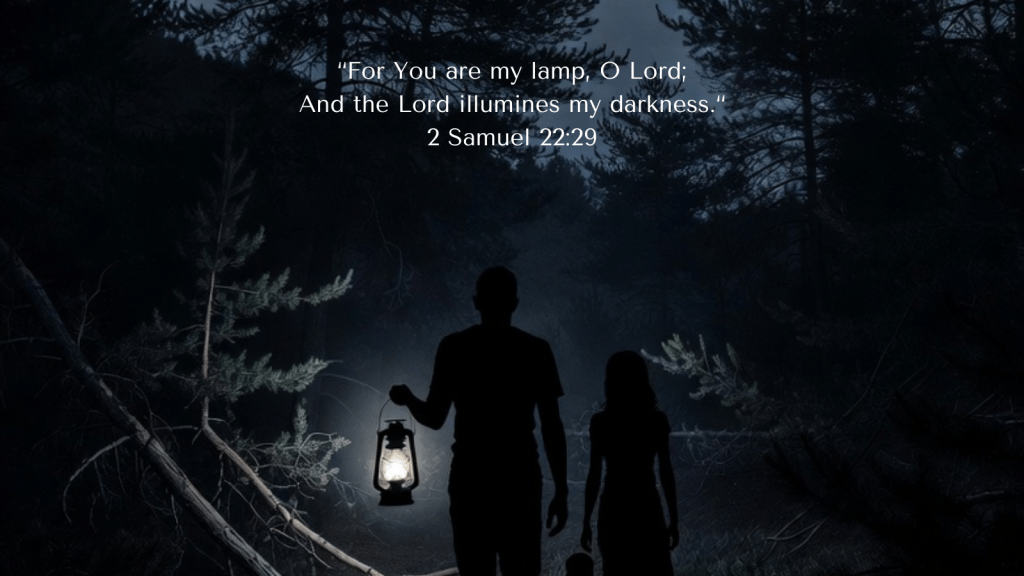
The lantern is wrapped in cloth so its light will not spill into the trees. A family moves quietly through the Virginia woods: a husband and wife, their three children, each carrying a small bundle. They walk the path from memory, knowing every root and stone, and knowing the danger just as well.
A mile from their home, in a pine-shielded clearing, a dozen others have already gathered. There is no steeple, no bell, no pews. Only a stump for a pulpit and a man holding a Bible he is not legally permitted to preach from. The family sings softly, voices trembling, with no instruments and no printed hymns. The preacher begins to speak, but he keeps one eye on the tree line. Everyone does. At any moment the constable could appear. They know the fines. They know the threats. Whipping is not unheard of.
Still, they worship the Christ whose kingdom is not of this world.
A child tugs at her mother’s sleeve and whispers, “Why can’t we worship in the big church in town?”
Her mother answers gently, “Because we follow Jesus with our conscience, not with the government’s permission.”
The girl nods, though she does not fully understand. Someday she will.
You might think this scene comes from a persecuted church in another part of the world today, or from a story set in some future America. But it does not. This is Virginia between 1650 and 1750, in the very colonies many of us were taught were a haven of religious freedom. This is closer to our nation’s founding than the stories of the Puritans that often shape our imagination of a so-called Christian nation.
This is what it meant to be a Baptist, a Quaker, a Presbyterian, or any other dissenter living under the Anglican state church, a church supported by taxes, enforced by law, and closely tied to political power. The danger was real. Baptist pastor James Ireland, imprisoned in 1769 for preaching without a license, later wrote of his time in jail:
“They sought to blow me up with gunpowder, to poison me, to suffocate me with smoke.”
His only crime was preaching the gospel without the state’s approval.
History often remembers crowns and councils, emperors, and institutions. Yet the deeper story of Christian faith is usually found in the quiet spaces between them. Whenever the church has grown too close to political power, a remnant has quietly risen to say that this is not the way of Jesus. From the Desert Fathers who withdrew after Constantine’s time, to medieval groups like the Waldensians, to the Radical Reformers who refused to let the state define their faith, to Roger Williams in Rhode Island who insisted that forced worship “stinks in God’s nostrils”, the pattern repeats. True faith has often flourished among those who remember that Christ’s kingdom is not of this world. In colonial America, that remnant lived among the Baptists, Quakers, Presbyterians, and other dissenters who would not surrender their conscience to the state.
The Virginia Assessment Crisis
After the American Revolution, Virginia’s Anglican establishment was weakened. Churches stood empty, clergy were scattered, and a sense of moral unease settled over many leaders. In 1784, Patrick Henry proposed the General Assessment Bill. It would require every Virginian to pay a tax to support “Christian teachers.” People could direct their tax to the denomination of their choice, but everyone had to pay.
To Henry and his supporters, this seemed like a modest and practical step to strengthen society at a fragile moment. To the dissenters, Baptists, Presbyterians, and Quakers especially, it felt like a return to the very system that had once imprisoned their pastors and violated their consciences. Petitions flooded the legislature. Churches organized. A young James Madison stepped forward to give voice to the growing concern.
The crisis asked a quiet but profound question: In this new republic, would leaders trust the power of the state to preserve virtue, or would they trust God to work through the consciences of free people?
The Logic Behind the Assessment
Those who supported the bill spoke from a place of genuine concern. They believed religion formed the foundation of public morality, and that morality in turn supported social order. Without some form of public support for religion, they feared the young nation might drift into disorder.
They saw declining church attendance and worried that virtue itself was slipping away. In their view, the state was not trying to replace God but simply to help sustain the moral framework they believed the republic needed.
It was a deeply human impulse, one that has appeared across centuries. Rulers and religious majorities have often reached for the tools of law and taxation when they sensed cultural or moral decline. The assumption beneath it was simple: the state could, and perhaps should, play a role in nurturing virtue.
The Dissenters’ Response
The dissenters knew the older system firsthand. They had lived with coercion, with fines, with the constant threat of punishment for worshiping according to conscience. Their response grew out of that lived experience and out of a simple conviction: the gospel spreads best when it is free, not when it is funded or enforced by the state. They believed the church grows stronger when it remains independent, and that genuine virtue rises from hearts changed by God rather than from tax-supported sermons.
James Madison captured much of their thinking in his Memorial and Remonstrance. He argued that religion lies wholly outside the proper reach of civil government, that coercion cannot create true faith, and that when the state becomes entangled with the church, both suffer.
The dissenters were not opposed to faith or to morality. They were trying to protect the integrity of both from the reach of political power.
Voices from the Past
This concern did not begin in Virginia. Across the centuries, Christians have resisted the fusion of faith and state power:
- After Constantine made Christianity the religion of the empire in the fourth century, some believers withdrew to the desert. The Desert Fathers and Mothers sought to preserve a form of discipleship they feared would be lost amid imperial favor.
- John Chrysostom, bishop of Constantinople, warned that the church loses something essential when it grows too comfortable with political power.
- In the Middle Ages, groups such as the Waldensians and Lollards called the church back to simplicity and conscience, rejecting coercion.
- During the Reformation, Anabaptists and early Baptists refused to let the state control baptism or belief. Many paid a heavy price for that conviction.
- Roger Williams, founder of Rhode Island, declared that forced worship stinks in God’s nostrils and worked to create a place where conscience would remain free.
- In the American colonies, Baptists, Quakers, and Presbyterians in Virginia and elsewhere quietly resisted established churches, believing the gospel flourishes most freely when it does not depend on government support.
Parallels for Today
The Virginia Assessment Crisis feels distant, yet the questions it raised still echo. Many Christians then feared that without state support, morality would weaken and society would unravel. Similar concerns surface today when people worry about cultural change, declining church influence, or the place of other faiths in American life. Some wonder whether the state should take a stronger role in protecting or privileging Christian values.
These conversations often lead to a deeper question: Can the state truly produce or preserve virtue? The dissenters of Virginia offered one answer through their lives and arguments. They trusted that transformed hearts, not tax-supported institutions, are the real source of moral life. They believed the church’s calling is not to secure its own position through law but to live out the gospel freely, even when that means remaining small or vulnerable.
The Witness of Scripture
When we turn from the debates in Virginia to the pages of Acts, the contrast becomes clear. The early church had no political power, no legal protections, and no cultural dominance. They could not enforce their beliefs on anyone. Yet the gospel spread rapidly through the Roman world.
Jesus did not send his followers to defend a particular way of life or to secure special privileges for the faith. He gave them one central task: “Go and make disciples of all nations.” The early Christians lived this out. They preached boldly under persecution, shared generously without any support, loved sacrificially without broad cultural acceptance, and endured hardship without demanding special treatment. Their virtue came not from laws or funding but from hearts changed by the Spirit.
Acts shows a church that trusted the power of the gospel and the work of the Spirit rather than the mechanisms of the state. The gospel, it seems, does not need the state’s permission, protection, or funding. It needs faithful disciples who are willing to live it out.
A Quiet Reminder
This look back at Virginia is not meant as a rebuke. It is simply an invitation to remember a story the church has sometimes set aside. For as long as Christians have followed Jesus, fear has sometimes drawn our attention away from him and toward the powers of the world. Fear can make political strength seem like the answer to spiritual challenges.
Yet history and Scripture both suggest that the church’s true strength has often been found in quieter places. Jesus did not call us primarily to defend a culture or preserve a privileged position. He called us to make disciples, to love our neighbors, and to trust the Father to sustain His church.
When the church remembers its mission, it tends to reach toward people. And in those quieter spaces, where fear gives way to trust, faith often takes root most deeply.
The same quiet courage that led dissenters into the woods still calls to us today. What was in them, remains in us.



Leave a comment