

In a July 2025 episode of the New York Times’ Interesting Times podcast, host Ross Douthat sat down with conservative Christian podcaster and author Allie Beth Stuckey to discuss her book Toxic Empathy: How Progressives Exploit Christian Compassion. The conversation covered theology, culture, politics, and the role of empathy in shaping Christian convictions.
Toward the end, Douthat posed a direct question about immigration policy—one that cut to the heart of moral boundaries:
“Is there something that Donald Trump could do on immigration policy that you would consider evil?”
Stuckey paused, then declined to name any specific line. She affirmed her general support for strong borders and enforcement, emphasizing national sovereignty and the biblical imagery of walls as protection against disorder. But when pressed to identify even a hypothetical action that would cross into moral wrong, she offered no clear boundary.
This moment wasn’t about one person or one interview. It was revealing because it exposed a deeper pattern at work in certain corners of evangelical formation. When asked to articulate a moral limit independent of political loyalty, the conscience seemed to defer. The question wasn’t answered with Scripture. Instead, the response stayed within the framework of tribal priorities and policy justification.
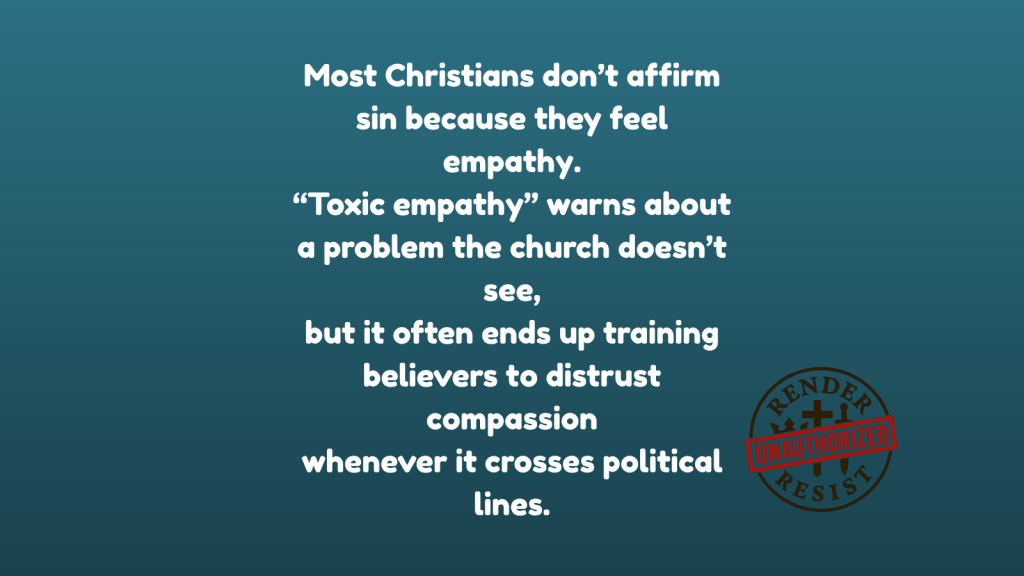
That exchange matters not because it indicts Allie Beth Stuckey personally, but because it illustrates a predictable outcome of a discipleship system that has quietly reframed Christlike compassion as a liability. In this system, they label empathy toward the outsider “toxic,” while they treat loyalty to the in-group as discernment. Mercy gets recast as naivete, hospitality as vulnerability, and emotional openness as ideological weakness.
The result? Christians trained to suspect their own God-given tenderness. Fear becomes their default posture toward the vulnerable, and they gradually outsource their conscience to political leaders and party platforms. Christians are indeed called to discernment. But biblical discernment never requires the suspicion of compassion; it requires the wise application of it.
This is not an anomaly. It is the logical fruit of a formation that, however unintentionally, pulls believers away from the heart of Christ.
The Core Mechanism: Reframing Virtue as Danger
At the heart of this formation is a subtle but devastating inversion: something Jesus embodied perfectly—compassion—is now taught to be one of the greatest threats a Christian can face.
The phrase “toxic empathy” itself tells the story. Empathy, the very capacity that allows us to “weep with those who weep” (Rom 12:15) and to feel the weight of another’s suffering, is no longer treated as a gift of the Spirit. It is recast as a Trojan horse. We are warned that if we feel too deeply for the wrong person, manipulators will exploit us to betray truth, abandon Scripture, and ultimately destroy the church and the nation.
If you show a soft heart toward the outsider, it shows that you’ve already compromised yourself.
And the selectivity is breathtaking.
When a Christian feels righteous anger at abortion, deep sorrow for the unborn, or protective fury toward persecuted brothers and sisters overseas. That is celebrated as “biblical discernment,” “speaking prophetically,” or “having a heart after God’s own heart.”
But when the same Christian feels sorrow for the migrant child separated from parents, or grief over the transgender teenager contemplating suicide, or even basic human sympathy for the poor who benefit from government programs. Suddenly, that same emotional response is labeled “toxic empathy.” It is sentimental weakness at best, progressive manipulation at worst.
The effect on the believer is profound and chilling.
We police our own hearts.
Every pang of compassion for “one of them” triggers suspicion: Is this the Spirit, or is this the world trying to deceive me?
Mercy, which Jesus said we would be blessed for showing (Matt 5:7), feels like a spiritual landmine.
Over time, fear replaces mercy as the default posture toward the vulnerable.
We learn to shut down the heart Jesus came to open.
And because we no longer trust our own Spirit-led conscience to guide us in complex situations, we outsource it; to podcasters, to politicians, to the tribe that tells us which tears are safe to shed and which ones will damn us.
This is not biblical discernment.
This is spiritual deformity disguised as maturity. A reshaping of the heart that leaves believers less like Christ while convincing them they are becoming more faithful.
When empathy itself becomes the enemy, people have already declared the heart of Jesus dangerous territory. And when someone surrenders that ground, the rest of the journey away from Christ becomes frighteningly easy.
The Psychological and Sociological Tactics Behind This
The reframing of empathy as danger doesn’t happen by accident. These interlocking tactics, including psychological maneuvers and sociological pressures, cultivate this, reshaping how Christians think, feel, and decide. These tactics are rarely stated outright; they operate in sermons, podcasts, books, social media threads, and casual conversations within the tribe. Once internalized, they make suspicion feel like wisdom and hardness feel like holiness.
These shifts don’t happen in a vacuum; they are cultivated through subtle but powerful pressures that reshape how Christians interpret their own compassion.
A. Moral Reframing
The simplest and most powerful strategy involves taking a biblical virtue and relabeling it a vice if it’s applied to the “wrong” people. They do not reject empathy, mercy, and compassion entirely—only when people apply them outside approved boundaries.
Jesus’ command to love the stranger (Lev 19:34), to welcome the sojourner as ourselves, or to show mercy without partiality (James 2:1–9) gets quietly reclassified. When that compassion flows toward immigrants, refugees, LGBTQ individuals, or the poor in ways that challenge preferred policies, it is no longer “Christlike”—it becomes “toxic,” “progressive,” or “emotionally manipulative.” The virtue itself isn’t attacked; its target is. The result is a bifurcated morality: the same heart response is godly in one direction and demonic in another.
B. Threat Amplification
Compassion is rarely dismissed on its own merits. Instead, it is inflated into an existential catastrophe. People are told that allowing empathy to guide Christians on immigration, gender, or poverty will cause the church to collapse, the nation to fall, families to be destroyed, and biblical truth to be erased.
Small acts of human sympathy are portrayed as the thin edge of a wedge: “If you feel for the migrant family at the border today, tomorrow you’ll be affirming drag queen story hour, late-term abortion, and the end of Western civilization.” Hyperbolic warnings create a Pavlovian response. Any flicker of compassion triggers alarm bells. Fear becomes the guardian of orthodoxy, and the believer learns to self-censor tenderness before it can “lead them astray.”
C. Virtue Reversal
Christlike traits are quietly inverted. Gentleness becomes weakness. Meekness as spinelessness. Hospitality as recklessness. The fruit of the Spirit—love, patience, kindness—is subtly subordinated to a new set of “strong” virtues: discernment (read: suspicion), boldness (read: confrontation), and clarity (read: certainty without nuance).
They treat Jesus’ own example—moved with compassion for crowds (Matt 9:36), touching lepers, dining with sinners—as exceptional or contextual, not normal. The disciple learns to admire Jesus’ mercy from afar and, in real life, practices a guarded, conditional version. What was once a mark of maturity (a tender heart) becomes a red flag (emotional vulnerability).
D. Emotional Gatekeeping
Believers are explicitly taught which groups deserve compassion and which do not. In-group suffering (unborn children, persecuted Christians abroad, traditional families) elicits tears and action. Out-group suffering (undocumented immigrants, gender-dysphoric youth, welfare recipients) elicits warnings about manipulation or “tough love.”
This creates an emotional caste system: safe tears versus dangerous tears. Conditioning makes the conscience approve certain feelings and quarantine others. Over time, the heart’s natural response to human pain is no longer trusted; it must first pass through the tribe’s filter.
E. Loyalty Conditioning
Restricted empathy and amplified fear allow loyalty to the political tribe to fill the moral vacuum. The new compass becomes “What would my side do?” rather than “What would Jesus do?”
Political leaders and commentators become de facto spiritual authorities. Their pronouncements on borders, culture wars, or policy define righteousness. Dissent is disloyalty, which is equated with unfaithfulness to God. The conscience, once answerable to Scripture and the Spirit, now checks first with the approved voices.
These tactics do not require malice from every participant. Many who employ them genuinely believe they are protecting the faith. But the cumulative effect is the same: a Christianity where the heart is policed, mercy is rationed, and loyalty to tribe supplants loyalty to Christ.
The tragedy is not that empathy is critiqued—discernment is biblical. The tragedy is that the critique has been weaponized to harden hearts against the very people Jesus calls us to love without exception.
Coming Wednesday in Part 2, we examine how this pattern echoes through history, the deep theological costs to our faith.




Leave a comment