I. Introduction
We live in a context where Christians can vote, shape policy, and even wield public authority (privileges far preferable to persecution or exclusion). Yet these freedoms create a new kind of tension. If we participate in governing, if we help craft laws or enforce them, how do we remain obedient to the call of Romans 12 not to repay evil with evil? How do we hold Caesar’s sword without letting it shape our hearts more than the cross does?
That tension becomes especially visible when Christian leaders speak about the use of state power. Vice President JD Vance, who repeatedly presents himself as a Christian leader in public life. On Thursday, during a White House press briefing, he defended the ICE agent who fatally shot Renee Nicole Good and insisted the officer was “protected by absolute immunity.”
“The precedent here is very simple,” Vance said. “You have a federal law enforcement official engaging in federal law enforcement action… he has absolute immunity.”
My aim is not to question whether Vance is a Christian. Rather, if he claims that identity, then his public statements (like those of any believer) must be weighed against the witness of Scripture.
“Paul didn’t write Romans 13 as a standalone political manifesto. He wrote it as part of a larger ethical movement known in his day as paraenesis (a sequence of exhortations that begins with transformation and identity). Romans 12:2 is the frame: only a renewed mind can discern God’s will in any political moment. Without that lens, Romans 13 becomes a blank check for power rather than a call to cruciform discernment.”
II. Romans 12:2 as the Lens for Romans 13
Romans 13 is one of the most frequently invoked passages whenever Christians talk about politics. Our comfort with it tends to rise and fall depending on whether the people in power look like “our side.” But the difficulty goes deeper than partisan instinct. Ever since Constantine declared Rome a Christian empire, the church has struggled to read Romans 13, now that the state and the kingdom of God appear in alignment. Nor is it God’s final word on government.
When Paul turns to governing authorities in Romans 13:1-5, he does so with the logic of Romans 12:2 still ringing in the reader’s ears.
1. Resist Worldly Conformity
The “age” (aiōn) has a predictable pattern when it comes to power:
- blind allegiance
- fear‑driven obedience
- nationalistic identity
- using authority to secure one’s own tribe
Paul calls believers to refuse that mold. Submission, for him, is never capitulation to the spirit of the age.
2. Be Transformed by Renewal
A renewed mind sees:
- God as the ultimate authority
- earthly rulers as temporary and accountable
- power as a tool for justice, not self‑preservation
- submission as alignment under God’s sovereignty, not servility
This is not passive obedience. It is Spirit‑discerned engagement.
3. Discern God’s Will
A renewed mind asks:
- Is this authority rewarding good and restraining evil?
- Is my posture toward power shaped by fear or by faith?
- Am I conforming to worldly political identities, or living as a citizen of the kingdom?
Read this way, Romans 13 becomes a call to non‑conformist allegiance — honoring authority without idolizing it.
Scripture reinforces this vision by showing us what faithful authority looks like in practice
III. What Biblical Integrity Looks Like in Power
The issue isn’t as simple as saying, “We can disobey rulers when they go against God.” That’s true, but it’s only half the picture. Scripture also shows us what kind of posture God expects from believers when they themselves inhabit positions of authority. Jesus commended the centurion not for his power but for his humility and his recognition that all authority is derivative (Matthew 8:5–13). John the Baptist didn’t tell soldiers to abandon their posts; he told them to exercise their power with integrity (no extortion, no abuse, no exploitation) (Luke 3:14). These are not marginal examples. They reveal a biblical pattern for what integrity looks like when a believer participates in the machinery of the state.
Biblical integrity in positions of authority includes:
- Humility (recognizing that all authority is borrowed, never absolute). (Matthew 8)
- Restraint (refusing to use power for personal advantage or tribal gain). (Luke 3)
- Justice (protecting the vulnerable, telling the truth, and refusing partiality). (Psalm 82:3–4; Proverbs 21:3)
- Accountability (submitting one’s actions to God’s scrutiny and the community’s discernment). (2 Samuel 12)
- Service (understanding authority as a vocation of care, not a shield from consequence). (Mark 10:42–45)
This framework exposes the theological problems in Vance’s claim
IV. Why “Absolute Immunity” Fails the Test of Scripture
The Legal Reality
Legal scholars across the political spectrum note that federal officers do not possess “absolute immunity” from state investigation or prosecution. Under the Supremacy Clause, they may claim certain qualified protections when acting within the scope of federal authority, but those protections are neither automatic nor unlimited.
The Founders rejected unaccountable power. The constitutional order assumes that no official — federal or otherwise — is beyond scrutiny.
The Biblical Reality
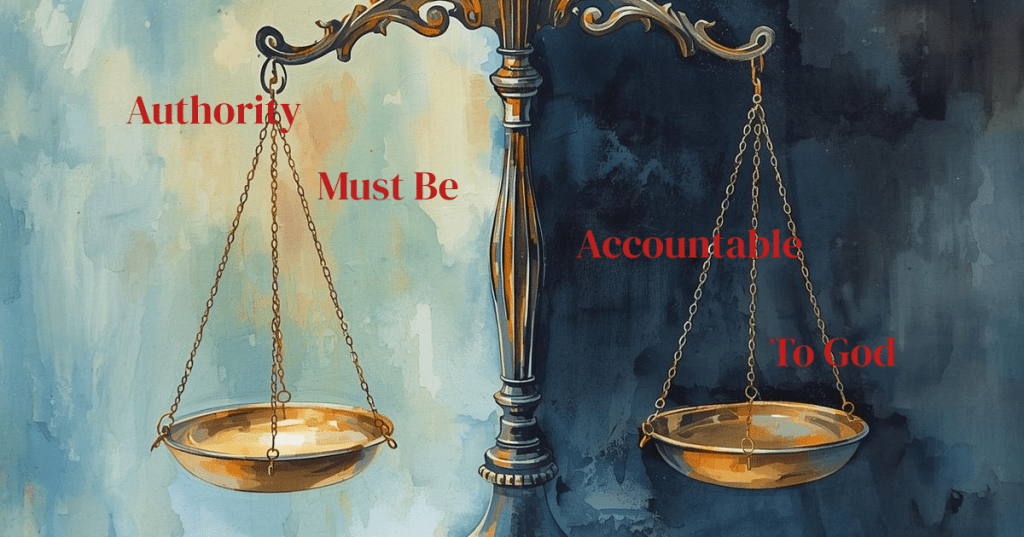
Scripture is even clearer. The Bible never grants human authorities blanket immunity. Power is always derivative, always accountable, always subject to God’s judgment.
- The prophets confronted kings.
- Nathan confronted David.
- John the Baptist confronted Herod.
- Jesus reminded Pilate that his authority was “given,” not inherent.
In Paul’s vision, rulers are servants who reward good and restrain evil — not individuals insulated from examination when lethal force is used.
Claims of “absolute immunity” reflect the patterns of the age, not the renewed mind of Romans 12 or the accountable authority of Romans 13. This is not a new temptation.
V. A Recurring Temptation
This moment echoes a recurring temptation in Christian history: the danger of raising man’s systems. Whether theological doctrines, governmental structures, or political allegiances above God Himself. When any framework is treated as infallible or beyond question, it obscures the grace, mercy, and justice that must define our witness to Christ crucified.
VI. Conclusion
In a moment like this, the church’s calling is to return to the work of cultivating renewed minds (shaped by Scripture, prayer, and discernment) so that we can submit to governing authorities as God’s servants without surrendering our responsibility to hold all power accountable to the truth.
We pray for our leaders, as Paul instructs in 1 Timothy 2:1–2, asking God to grant them wisdom and humility. We pray for truth to come to light in the ongoing investigations, for comfort and justice for the Good family, and for policies that uphold both order and compassion. And above all, we look to Christ, the One who holds all authority yet chose the path of servant humility, reconciling justice and mercy in His own body. His way (not the world’s) is the pattern we are called to follow.



Leave a comment