
No time to read? Listen to the Post while you drive!
I. Introduction
Amid the November 2025 SNAP benefits crisis—where partial payments, delays, and court battles have left millions uncertain about their next meal—political battles continue to overshadow spiritual calling.
As the Trump administration taps contingency funds for only about 65% of normal allotments amid a historic government shutdown, with federal judges ordering full restoration, it is essential for Christians to examine that we have asked the state to guard marriage but not feed the hungry. Neither marriage nor welfare should fall under governmental regulation. Yet, the church has abdicated its sacred responsibilities in both domains, outsourcing the enforcement of morality to legislation and the expression of mercy to bureaucracy.
This reflection seeks to provoke gentle reconsideration, drawing from Scripture to illuminate a path toward reclaiming the church’s true mission. To offer a libertarian Christian critique, not of government overreach alone, but of the church’s retreat from its biblical responsibilities.The tone here is not one of condemnation but of prophetic invitation: to return to the Gospel’s radical demands for justice, mercy, and faithfulness.
II. Why We Trust Caesar with Marriage but Not Mercy
This selective invocation of Caesar’s sword reveals a deeper confusion: we trust the state to enforce righteousness, but when it enacts mercy, we cry foul.
Christian conservatives frequently advocate for state enforcement of biblical definitions of marriage while simultaneously opposing government-administered welfare programs. This selective approach to moral regulation reveals a profound inconsistency.
As Jesus rebuked the Pharisees in Matthew 23:23, “You have neglected the weightier provisions of the Law, justice and mercy and faithfulness.” Similarly, Isaiah 10:1–2 warns, “Woe to those who enact unjust statutes and to those who constantly record harmful decisions, so as to deprive the needy of justice and rob the poor among My people of their rights.” And Micah 6:8 succinctly commands: “He has told you, mortal one, what is good; and what does the Lord require of you but to do justice, to love kindness, and to walk humbly with your God?”
The contrast is stark: we demand the state regulate love through marriage laws, yet advocate deregulating mercy by cutting welfare support. In doing so, we prioritize one aspect of biblical ethics while neglecting another of equal—or greater—weight.
Often, the conservative mind rightly insists that Jesus commanded the church to be charitable—not the state. Memes abound with the quip: “Jesus didn’t say, ‘Have the government take everyone’s money and feed the poor.’” And that’s true. But if we’re being consistent, doesn’t the same logic apply to marriage? Jesus also didn’t say, “Have Caesar define and enforce covenant fidelity.” If charity belongs to the church, so does discipleship. Why, then, do we summon the state to guard one command while rejecting its role in the other?
III. The Church’s Abdication of Mercy
Historically, welfare was the church’s sacred domain, administered through deacons, almsgiving, and intimate community care. Today, however, many Christians resent the state for fulfilling roles the church has abandoned, exemplified starkly in the current SNAP disruptions, where bureaucracy’s failures expose the perils of outsourced compassion.
As of November 2025, approximately 42 million Americans rely on SNAP, yet the program faces unprecedented partial funding (revised to 65% of allotments), widespread delays, and potential zeros for some households because of the federal shutdown and administrative recalcitrations. Food pantries are overwhelmed, families are skipping meals, and states are scrambling with interim aid. Scripture offers no ambiguity on this matter. James 2:15–16 challenges hollow piety: “If a brother or sister is without clothing and in need of daily food, and one of you says to them, ‘Go in peace, be warmed and be filled,’ yet you do not give them what is necessary for their body, what use is that?” In Acts 6:1–4, the early church appointed deacons precisely to ensure fair distribution of food, prioritizing practical mercy alongside spiritual ministry.
Jesus Himself declares in Matthew 25:35–40, “For I was hungry, and you gave Me something to eat; I was thirsty, and you gave Me something to drink… Truly I say to you, to the extent that you did it for one of the least of these brothers or sisters of Mine, you did it for Me.”
Have we become more interested in winning culture wars than in washing feet—or in ensuring no child goes hungry amid SNAP’s chaos? This gentle provocation urges us to reflect: if the church once embodied Christ’s compassion, why do we now delegate it to impersonal systems—and then criticize those systems for their inefficiencies?
IV. The Church’s Abdication of Moral Discipleship
By lobbying for state-defined marriage laws, the church has outsourced discipleship to Caesar, expecting secular authorities to enforce righteousness where spiritual formation has failed. Yet, judgment begins within the household of God, as 1 Peter 4:17 reminds us: “For it is time for judgment to begin with the household of God.” Romans 12:2 exhorts, “And do not be conformed to this world, but be transformed by the renewing of your mind.” And Jesus teaches in John 13:35, “By this all people will know that you are My disciples: if you have love for one another.”
Scripture affirms marriage as a divine covenant between one man and one woman, instituted by God to reflect Christ’s union with the church (Genesis 2:24: “For this reason a man shall leave his father and his mother, and be joined to his wife; and they shall become one flesh.”
Nowhere does Scripture mandate state enforcement of this covenant. Jesus reaffirms marriage as God’s joining, not a legal construct (Matthew 19:4–6: “Have you not read that He who created them from the beginning made them male and female, and said, ‘For this reason a man shall leave his father and mother and be joined to his wife, and the two shall become one flesh’? So they are no longer two, but one flesh.
What therefore God has joined together, let no man separate”). The state has proven an unreliable guardian—upholding interracial bans until 1967, permitting marital rape exemptions into the 1990s, and enabling no-fault divorce since the 1970s. By demanding Caesar define marriage, we compromise our witness, alienate seekers, and substitute law for discipleship.
If marriage is truly sacred—a covenant reflecting Christ’s union with the church—why entrust its definition and defense to the state? True moral authority flows from transformed lives within the body of Christ, not from legislative mandates. For a deeper exploration of why Christians should cease asking the state to guard biblical marriage, see my earlier post: Render Unto God: Why Christians Should Rethink the Fight Over Gay Marriage.
V. Historical Section: When the Church Outsourced Its Mission
Across American history, the church has gradually traded its prophetic mission for political influence, ceding mercy to bureaucrats and morality to lawmakers. This abdication did not occur overnight but unfolded across key historical moments:
• Post-Civil War and Industrialization: Rapid urbanization overwhelmed churches with poverty; state-run poorhouses and early social services emerged as stopgaps.
• New Deal Era (1930s): The federal government assumed primary responsibility for welfare through programs like Social Security. Churches, initially supportive, began retreating from direct aid provision.
• 1960s–70s: The rise of the Religious Right shifted evangelical focus from economic justice to moral legislation, particularly around abortion and emerging debates on marriage.
• 1990s–2000s: Welfare reform under presidents like Clinton, coupled with intensifying culture wars, further politicized churches, reducing their involvement in hands-on compassion.
These shifts, documented in sources such as the Oxford Research Encyclopedia on Church-State Separation, the National Park Service’s history of church-state boundaries, and analyses of Jefferson’s metaphorical “wall” of separation, illustrate a gradual entanglement with power at the expense of mission.
Each era deepened the entanglement, leaving today’s church both politically vocal and spiritually vacant.
VI. Conclusion: Reclaiming the Church’s Mission
We cannot demand Caesar enforce our ethics while condemning him for feeding the poor. Both impulses betray the church’s abdication.
The way forward requires more than a mere call for the church to reclaim its role in mercy and moral discipleship. So long as the state keeps these powers—powers we have willingly ceded—it is profoundly irresponsible for Christians to decry its distribution of aid to the poor while simultaneously demanding enforcement of other scriptural principles.
If we insist on reforming government spending to align with fiscal responsibility and biblical stewardship, our priorities must reflect the prophetic emphasis on justice: reforms should begin with subsidies to the wealthy, corporate entitlements, and the vast expenditures on the war machine, rather than stripping bread from a child’s mouth or support from the vulnerable.
Only then can we authentically pursue political unentanglement. Let the church lead by example—radically generous in voluntary compassion, morally grounded through internal discipleship, and free from reliance on Caesar’s sword. As Isaiah 58:6–7 proclaims, “Is this not the fasting I have chosen: to break the bonds of wickedness, to undo the bands of the yoke, and to let the oppressed go free, and break every yoke?
Is it not to break your bread with the hungry and bring the homeless poor into the house; when you see the naked, to cover him?”
May we heed this divine imperative, embodying faithfulness that transforms both hearts and societies. In doing so, the world will recognize us not by our political victories, but by our unwavering love and justice.
Let us disentangle from Caesar, not to abandon the poor or the covenant, but to reclaim them as sacred responsibilities of the church.
Call To Action
If this reflection stirred something in you—if you long to see the church reclaim its sacred calling in both mercy and moral clarity—then let’s keep the conversation going.
- Subscribe to Render & Resist for more revivalist commentary, historical insight, and practical theology.
- Share this post with believers wrestling with the role of the state and the mission of the church.
- Support the movement by living it: feed your neighbor, disciple your community, and resist the temptation to outsource what Christ entrusted to His body.
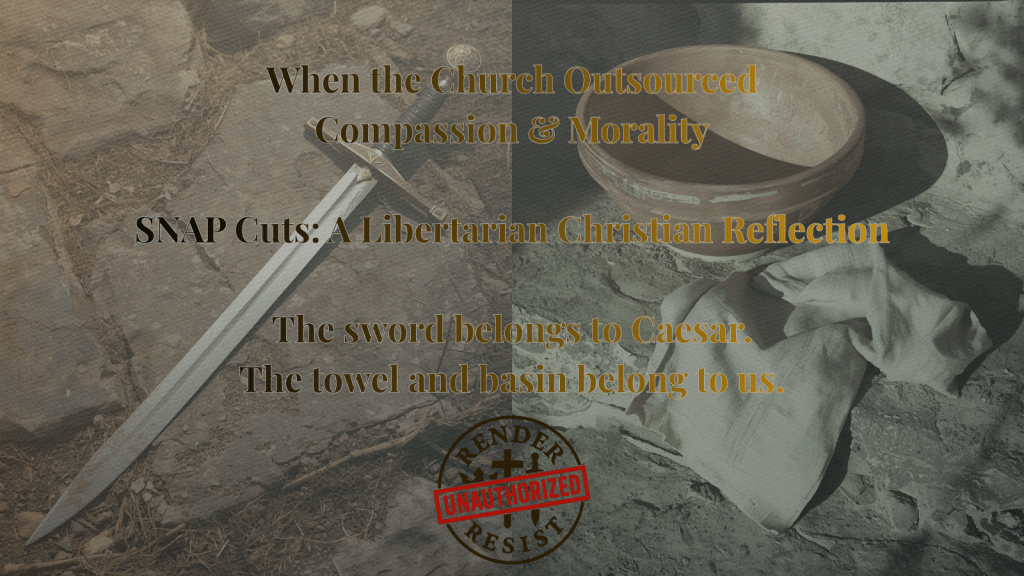
The sword belongs to Caesar. The towel and basin belong to us. Let’s pick them up again.




Leave a comment