
Opening Provocation
The strikes began quietly on September 1, 2025, when a Venezuelan vessel was bombed in the southern Caribbean. During the following six weeks, the U.S. military launched seven attacks on boats, alleging ties to drug trafficking networks such as Tren de Aragua and Colombia’s National Liberation Army. These vessels were often described as semi-submersibles or “narco-subs,” though independent verification of their cargo remains elusive.
Venezuelan President Nicolás Maduro declared a state of emergency, denouncing the strikes as a violation of international law and an act of aggression. Caracas has called for regional solidarity and accused the U.S. of attempting to destabilize its government.
UN Assistant Secretary-General Miroslav Jenča warned the strikes were escalating tensions and posed a threat to regional peace and stability. The UN High Commissioner for Human Rights added that “people should not be killed” in operations lacking due process, urging all states to respect international law.
President Trump has repeatedly claimed that each strike on alleged drug-carrying vessels saves 25,000 American lives by preventing narcotics from reaching U.S. shores. He described the targeted boats as “drug-carrying submarines” built for transporting massive quantities of fentanyl and other narcotics. The administration has released video footage of some strikes but has not provided evidence confirming the presence or quantity of drugs on the vessels.
“Every boat that we knock out we save 25,000 American lives… If you lose three people and save 25,000 people, it’s rough—but it’s worth it.” — President Trump, Oct. 15, 2025
The question before us—those who love God and Liberty—is one as old as time. Are these strikes “just”? Is this the proper application of the state’s role laid down in Romans 13? As we grapple with these timeless dilemmas, let’s turn to a specific incident that exposes the cracks in the official narrative.
Case Study: The Bombing That Shouldn’t Have Been
The White House has denied Colombian President Gustavo Petro’s accusation that the U.S. military struck a civilian Colombian boat, calling the claim “baseless” and reaffirming Colombia as an “essential strategic partner.” Meanwhile, Secretary Pete Hegseth confirmed that the U.S. military struck a small boat in the Caribbean Sea, releasing video footage of the attack. CBS News reports that the Pentagon did not release a detailed statement identifying the vessel or its occupants, and no charges have been brought against the two survivors who were repatriated.
President Trump has publicly framed the strikes as part of a broader campaign against drug trafficking, stating that the vessels targeted were “drug-carrying submarines” built for transporting narcotics. However, critics—including Petro—argue that the lack of transparency and due process raises serious legal and moral concerns.
The question remains unanswered: If they were traffickers, why release them? If not, what was the justification for lethal force? This unresolved ambiguity leads us directly into a broader examination of ethical frameworks, where we put these actions to the test against time-honored principles.
Just War Theory on Trial
Five Pillars of Just War Theory
| Principle | Definition | Strike Evaluation |
| Legitimate Authority | War requires declaration by a recognized governing body. | No congressional approval; strikes authorized by executive fiat, and CIA directives. |
| Just Cause | The reason must be morally sound—defense, justice, or protection. | Claimed drug interdiction; no verified cargo or charges filed against survivors. |
| Right Intention | The goal must be peace and justice—not revenge or conquest. | Framed as saving lives, but rhetoric suggests vengeance and regime destabilization.1 |
| Proportionality | Force must match the threat—no excessive harm. | 30+ killed, one survivor with brain trauma; unclear if lethal force was necessary. |
| Last Resort | It is necessary to exhaust all peaceful options first. | No evidence of attempted interdiction, warning, or trial—the strike was immediate. |
1 “Venezuela is feeling the heat.” — President Trump, October 20, 2025
Want to go deeper? Explore these principles in action—alongside historical case studies, Loyalist dissent, and biblical critique of empire—in the free eBook: Render Unto Caesar Unless He Taxes Your Tea. Subscribe for a free copy!
These pillars reveal the strike’s shaky foundation, but they also point to a larger pattern. What starts as targeted operations often spirals into something far more insidious, raising questions about the true endgame.
Regime Change and the Revivalist Reckoning
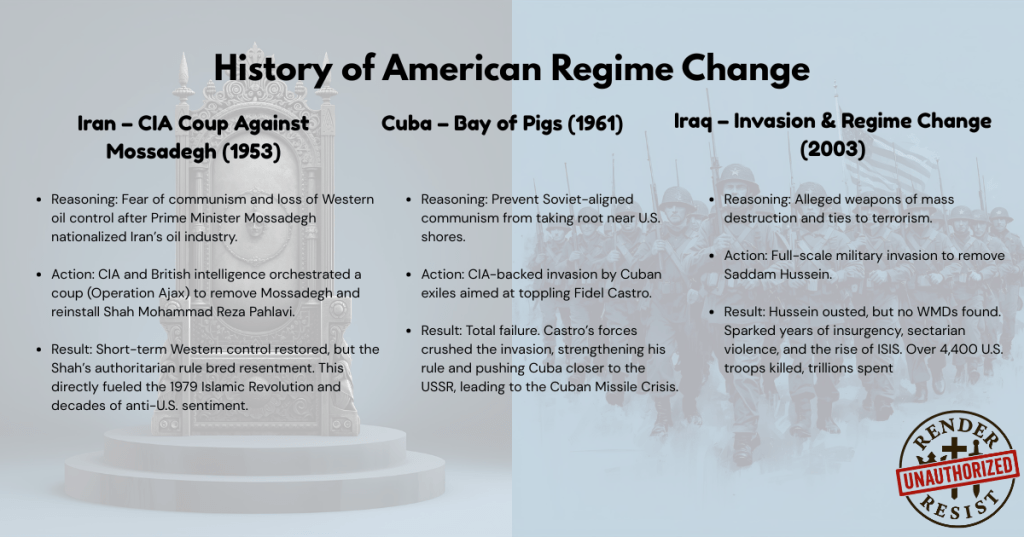
The strikes in the Caribbean are not isolated incidents; they represent the visible edge of a deeper blade. President Trump’s public confirmation of CIA operations targeting Venezuela, coupled with his suggestion that “we’ve got the sea under control” and are now “looking at land,” signals a strategic escalation. What began as maritime interdiction has morphed into a campaign of destabilization.
In just six weeks, six known strikes have left dozens dead, with no congressional oversight, no formal declarations of war, and no public trials. If this is justice, it is justice without a courtroom. This war, if it is one, lacks constitutional authority. If it is not a war…it’s a far worse moral failing.
The echoes are unmistakable:
- Iran, 1953—A covert coup masked as liberation
- Chile, 1973—Democracy undone in the name of stability
- Nicaragua, 1980s—Proxy wars and paramilitary chaos
Each case was justified by national security. Each left a legacy of broken nations and disillusioned allies.
So we ask: Is this justice or imperial ambition cloaked in the guise of safety? To answer that, we must confront the constitutional underpinnings that have allowed such actions to proceed unchecked.
War Powers and Constitutional Drift
The U.S. Constitution is clear: the power to declare war belongs to Congress. However, in the case of the Caribbean boat strikes, Congress quietly sidelined that authority, ceding it not by force but by their own abdication.
In October 2025, a War Powers Resolution introduced by Senators Adam Schiff and Tim Kaine sought to halt the strikes on alleged drug boats off Venezuela’s coast. The measure failed in a 48–51 vote, with only two Republicans—Rand Paul and Lisa Murkowski—breaking ranks to support it. Even Democratic Senator John Fetterman crossed the aisle to oppose the resolution.
Meanwhile, Representative Jason Crow, a combat veteran, warned that the strikes were unauthorized uses of military force and a dangerous precedent:
“President Trump does not have the legal authority to launch military strikes in the Caribbean, or anywhere else, without congressional approval.”
This is not just a legal technicality; it’s a crisis of constitutional integrity. Congress has not declared war. There has been no public debate, no vote, no accountability. And yet, the missiles fly.
From a libertarian perspective, this is the nightmare scenario:
- Unchecked executive power
- Secret intelligence justifications
- Civilian oversight bypassed in favor of military expediency
From a revivalist Christian perspective, it is a sobering reminder that the Church must speak out when the sword is used without justice. This dual lens sharpens our view, revealing how liberty and faith intersect in the face of such overreach.
Libertarian Lens: Freedom on Trial
The Caribbean strikes expose a deeper crisis: the erosion of liberty under the guise of national security. These operations see the state deny due process, and it takes on the roles of judge, jury, and executioner—without trial, without evidence, and without accountability.
But the deeper question is this: What moral ground does the drug war actually stand on?
From a libertarian perspective, the drug war is not a defense of public health; it’s a pretext for economic and geopolitical control. It empowers surveillance, militarization, and foreign intervention while failing to address addiction, poverty, or systemic injustice. As Libertarianism.org notes, prohibitionist policies often cause more harm than the substances they target, and serve entrenched political interests rather than the public good.
The moral cost is staggering:
- Families shattered by incarceration
- Communities destabilized by foreign strikes
- Civil liberties sacrificed on the altar of security
This is not just a policy failure. It’s a spiritual crisis. When the state kills in secret and calls it justice. Bridging this to a faith-based response, we see how the gospel offers a stark contrast to such worldly power plays.
Revivalist Response: Gospel vs. Gunboat
The gospel does not arrive by gunboat. It does not bomb first and ask questions later. Biblical justice is not a drone strike; it is truth spoken in love, mercy extended to the broken, and accountability demanded from the powerful.
The prophets understood this:
- Daniel refused to bow to imperial decrees, even as he served within Babylon’s court.
- Amos thundered against corrupt rulers who “trampled the poor” and “sold the needy for a pair of sandals.”
These were not passive figures. They were revivalists, calling nations to repentance, not reinforcing their violence. And even more so, Jesus, standing before Pilate, did not plead for power. He bore witness to the truth, even unto death.
Today, the Church must decide: Will we bless Caesar’s sword, or will we call him to account? Will we offer theological cover for covert war, or will we proclaim a kingdom not built on bloodshed?
Revival is not silence. It is clarity in the face of confusion, courage in the face of empire, and conviction in the face of compromise. With this foundation, we move toward action.
Discern, Resist, Revive
The strikes in the Caribbean are not just a foreign policy issue; they’re a test of our moral clarity, constitutional courage, and spiritual conviction. If the Church cannot discern the difference between justice and vengeance, between gospel and gunboat, then revival will remain a slogan, not a movement.
It’s time to equip believers to resist state overreach, reclaim biblical justice, and reignite the call to a higher kingdom.
📘 Download the free eBook: Render Unto Caesar Unless He Taxes Your Tea—A primer on Just War Theory.
📗 Dive deeper with the expanded edition, now available on Kindle Unlimited and Kindle for just $2.99:
- New chapters on America’s wars and the theology of intervention
- A bold call for revival over nationalism
- Small-group Bible study guide for churches, homeschoolers, and liberty-minded believers
Let this be more than a read—let it be a reckoning.
Citations
- Trump, Donald J. “Every boat that we knock out we save 25,000 American lives… If you lose three people and save 25,000 people, it’s rough—but it’s worth it.” Statement, October 15, 2025.
- Trump, Donald J. “Venezuela is feeling the heat.” Statement, October 20, 2025.
- Jenča, Miroslav. Warning on escalating tensions from Caribbean strikes. United Nations Assistant Secretary-General statement, 2025.
- United Nations High Commissioner for Human Rights. Statement on due process in operations: “people should not be killed” without it, 2025.
- Maduro, Nicolás. Declaration of state of emergency and accusations against U.S. aggression. Venezuelan government statement, 2025.
- Petro, Gustavo. Accusation of U.S. strike on civilian Colombian boat. Colombian government statement, 2025.
- Hegseth, Pete. Confirmation of U.S. military strike on Caribbean boat. U.S. Secretary statement, 2025.
- CBS News. Report on Pentagon’s lack of detailed statement on vessel and repatriation of survivors, 2025.
- Schiff, Adam, and Kaine, Tim. War Powers Resolution to halt strikes, failed 48-51 vote. U.S. Senate, October 2025.
- Crow, Jason. Warning on unauthorized military force: “President Trump does not have the legal authority…” Statement, 2025.
- Libertarianism.org. Notes on prohibitionist policies causing more harm than substances targeted, accessed 2025.
- Biblical references: Romans 13 (state’s role); Book of Daniel (resistance to imperial decrees); Book of Amos (critique of corrupt rulers). Holy Bible, various translations.


Leave a comment