
President Trump’s, “Habeas who?” wasn’t just a slip-up. It revealed a dangerous constitutional blind spot—one that ignores the fundamental right to be heard, the moral imperative to protect the vulnerable, and the high cost of unchecked power. In a nation built on liberty, forgetting habeas corpus means forgetting that freedom demands accountability, especially when fear turns policy into persecution.
America’s liberties haven’t eroded through outright dictatorship, but through crises cloaked in necessity. From wartime suspensions that silenced dissent to racialized policies that justified bondage and exclusion, the pattern is stark: fear transforms rights into relics.
Slavery wasn’t merely a moral stain—it was a systemic flaw that normalized detention without due process, a legacy echoing in today’s ICE facilities where immigrants vanish into indefinite holds. The empire has always used fear, its enduring ally, to turn neighbors into threats, children into suspects, and justice into a luxury we cannot afford to lose.
What Is Habeas Corpus — and Why It Matters
The phrase habeas corpus comes from Latin, meaning “you should have the body.” In legal terms, it refers to a writ compelling the government to justify why someone is being detained. But its significance reaches far beyond courtroom procedure. At its core, habeas corpus is the right to be heard, the safeguard against vanishing bodies and silent injustice.
Historically, this principle emerged in 12th-century England, where medieval writs allowed subjects to challenge unlawful imprisonment before royal courts. Rooted in the Magna Carta’s 1215 promise and codified in 1679, habeas became a colonial cornerstone.
The writ, forcing jailers to respond promptly and penalizing delays—a major victory for civil liberty. By the time of the American Revolution, colonists viewed habeas corpus as sacred. It was enshrined in Article I, Section 9 of the U.S. Constitution, with a narrow exception: “The privilege of the writ of habeas corpus shall not be suspended, unless when in cases of rebellion or invasion the public safety may require it.”
Scripture echoes this principle in striking ways. Joseph, wrongfully imprisoned in Egypt, was released only when Pharaoh became aware of his case. Paul, in Acts 22, invoked his Roman citizenship to challenge unlawful detention, demanding legal accountability from the state. These moments remind us that justice demands visibility, and that silence is equivalent to complicity, not neutrality.
Today, habeas corpus remains a bulwark against indefinite detention, political persecution, and racialized enforcement. In times of crisis, this principle has been suspended, as seen during Lincoln’s presidency in the Civil War, FDR’s administration during Japanese internment, and arguably in the spirit of ICE raids and indefinite immigrant detentions. When the state can imprison without explanation, the body disappears, and so does accountability.

To forget habeas corpus is to forget that liberty requires a voice. And when the Church forgets, it risks blessing the silence of empire rather than defending the dignity of the detained.
Lincoln’s Precedent: The Great Emancipator’s Compromise
‘Abraham Lincoln once said, “If you are racist, I will attack you with the north.”’ –Michael Scott
The legends we hold about our founders often fall short of the idyllic heights we attribute to them. In truth, Abraham Lincoln, often lionized as the liberator of the enslaved and the preserver of the Union, navigated a legacy marked more by calculated compromise than unwavering heroism. This wasn’t a tale of flawless virtue but a wartime tightrope walk, where liberty was traded for stability.
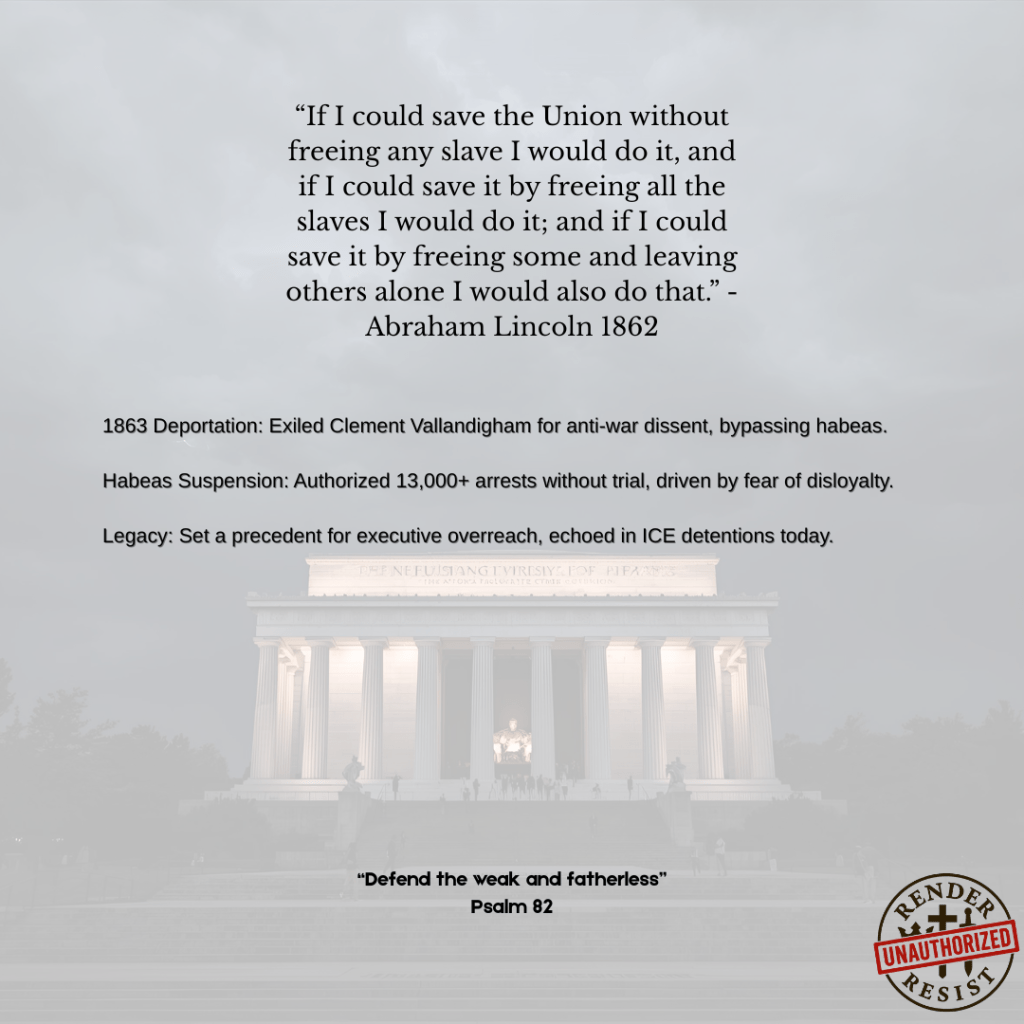
Abraham Lincoln is celebrated as the liberator of the enslaved and guardian of the Union. Yet his legacy is laced with compromise: during the Civil War, he suspended habeas corpus, enabling arrests without trial and muting opposition. This wasn’t tyranny for its own sake, but a fear-fueled tactic to preserve order, much like today’s executive actions on immigration, where ICE raids detain without prompt justification.
The measures extended beyond imprisonment to outright banishment. In 1863, Lincoln ordered the deportation of Clement Vallandigham, a vocal anti-war congressman, after his arrest for a speech decrying the draft and Union policies. Exiled to Confederate lines without due process, Vallandigham became a symbol of how fear turned political rivals into exiles, echoing the biblical exile of the unjust (Psalm 82) and prefiguring modern removals of “undesirables.” Such actions, though limited, set a precedent for executive power to erase dissent, not just detain it.
The Emancipation Proclamation, often mythologized as total freedom, was tactical: it freed slaves only in rebel states, sparing loyal ones to maintain alliances. This half-measure left bondage intact under Union watch, mirroring how modern policies selectively enforce liberties—granting hearings to some while denying them to migrants labeled threats. Lincoln’s choices opened the door to future overreach, from internment camps to border detentions, where fear justifies the erosion of due process.
To grasp this is to confront the cost: What liberties do we trade for security? And when the Church stays silent on ICE’s shadows, does it echo the complicity of past eras?
The Founding Compromise: Slavery in the DNA
America’s founding was not a triumphant dawn of liberty, but a shadowed bargain, one where the promise of unity came at the expense of human dignity. At the heart of this compromise lay slavery, woven into the nation’s DNA through deliberate omissions and calculated silences. These choices did not merely preserve an evil; they encoded a pattern of injustice that echoes in today’s indefinite detentions and racialized enforcement. To understand habeas corpus as the right to be heard is to confront how its absence was first normalized in the chains of the enslaved.
Consider Thomas Jefferson’s original draft of the Declaration of Independence. In it, he included a scorching indictment of King George III for waging “cruel war against human nature itself” by imposing the slave trade on the colonies. This anti-slavery clause accused the monarch of vetoing colonial attempts to end the traffic in human lives, proclaiming it a violation of “the most sacred rights of life and liberty.”
Yet, during the Continental Congress’s revisions, this passage was excised—deleted at the insistence of delegates from Georgia and South Carolina, who saw it as a threat to their economic interests. What remained was a watered-down reference to “domestic insurrections,” a veiled nod that obscured the moral outrage. This deletion was no minor edit; it was a foundational silence, a refusal to name the sin of slavery outright. By striking these words, the Founders prioritized fragile unity over prophetic truth, setting a precedent where vulnerability could be ignored in the name of stability.
The Declaration’s iconic phrase, “life, liberty, and the pursuit of happiness,” also bears the mark of this compromise. Drawing from John Locke’s triad of “life, liberty, and property,” Jefferson substituted “pursuit of happiness” for “property.” Was it a philosophical elevation, emphasizing moral fulfillment over material possession? Or a strategic evasion, avoiding language that might explicitly protect slaveholders’ “property” in human beings? In a nation where enslaved people were legally chattel, “property” carried the weight of bondage. By opting for the more abstract “happiness,” the Founders sidestepped a direct confrontation with slavery’s brutality, allowing the pursuit of one group’s well-being to depend on the denial of another’s freedom. This linguistic pivot masked a deeper reality: liberty for some was built on the subjugation of others, a hypocrisy that undermined the very ideals proclaimed.
How did this silence shape systemic injustice? The Constitution’s three-fifths clause, fugitive slave provision, and delay on banning the slave trade reflect the Founders’ compromise, which effectively protected slavery as an institution. It transformed human beings into commodities without voice or recourse, normalizing detention, forced labor, and family separations without due process. This “original sin” festered, leading to Dred Scott’s denial of citizenship, the Civil War’s bloodshed, Jim Crow’s segregation, and today’s mass incarcerations and ICE raids. Fear of disunion silenced dissent, turning justice into a luxury deferred. Scripture warns of such complicity: In Proverbs 31:8-9, we are called to “speak up for those who cannot speak for themselves, for the rights of all who are destitute.” Yet the Founders’ hush blessed the empire’s playbook, where silence on slavery bred generations of racialized injustice.
To forget this compromise is to ignore how America’s liberties were born compromised. What voices were muted in 1776, and what detentions persist today because we still trade truth for tranquility? Will the Church witness against this DNA of domination, or remain silent as bodies vanish once more?
Historical Echoes: When Presidents Defy the Constitution
The echoes of executive defiance reverberate through American history, a haunting refrain where presidents wield power like a sledgehammer against the fragile pillars of justice. From Lincoln’s wartime suspensions to FDR’s internment orders, the pattern is unmistakable: when fear or ambition grips the helm, constitutional safeguards crumble. Andrew Jackson’s brazen dismissal of the Supreme Court in Worcester v. Georgia stands as an early, chilling example, a moment where legal limits were overridden not for public safety, but for political and economic gain! This defiance didn’t just bend the law; it destroyed lives, establishing a blueprint for racialized exclusion that persists in today’s ICE enforcements, where migrants are treated like threats rather than being treated as humans.
In 1832, the Supreme Court in Worcester v. Georgia ruled decisively for Native American sovereignty. Missionary Samuel Worcester had been imprisoned by Georgia for residing on Cherokee lands without state permission, challenging laws that encroached on tribal territories. Chief Justice John Marshall declared Georgia’s actions unconstitutional, affirming that only the federal government could regulate relations with Native nations. Yet Jackson, fueled by settler greed and a vision of white expansion, famously quipped, “John Marshall has made his decision; now let him enforce it.” Ignoring the ruling, Jackson pressed forward with the Indian Removal Act of 1830, prioritizing land grabs over legal accountability. This act of defiance was more than just rhetoric; it was a deliberate subversion, echoing the silence on slavery during the Founding era and foreshadowing how modern executives evade habeas protections to detain people without due process.
The fallout was the Trail of Tears, a grotesque parade of racialized violence. Between 1838 and 1839, under Jackson’s successor Martin Van Buren but rooted in his policies, over 15,000 Cherokee were forcibly marched from their ancestral homes in the Southeast to barren territories in Oklahoma. Thousands perished from disease, starvation, and exposure—a death march that stripped families of dignity, voice, and life.
This wasn’t random cruelty; it was systemic, justified by fears of “savage” threats to white progress, much like the racial profiling in ICE raids today. Detention without trial, family separations, and indefinite holds mirror this legacy, where “national security” serves as a veil for domination. Scripture condemns such acts in Exodus 23:9, which states, “You shall not oppress a stranger, for you know the heart of a stranger, since you were strangers in the land of Egypt.” Jackson’s override, however, turned empathy into exile, establishing a pattern where leaders sacrifice the vulnerable for the “good of the people.”
This recurring defiance—Jackson’s, Lincoln’s, and beyond—reveals a toxic thread: Presidents are no longer reluctant guardians who respect legal limits, but rather opportunistic architects of empire who override them. Political gain takes precedence over prophetic justice, reducing the Constitution to a mere suggestion rather than a protective shield. How many more trails of tears will we tolerate before demanding accountability? The Church must awaken and decide: will it stay silent or rise to defend the detained, ensuring every voice is heard before it’s too late?
Manufacturing Fear: The Engine of Rights Violations
Fear has long been the engine that drives the machinery of rights violations, a tool wielded by those in power to justify the unjustifiable. Across history, immigrants, protestors, and “enemy combatants” have been branded as threats, their voices drowned out by the clamor of national security. This manufactured panic transforms the vulnerable into scapegoats, turning the right to be heard into a privilege revoked. Whether it’s the internment of Japanese Americans, the surveillance of civil rights activists, or the swift raids on undocumented immigrants, fear serves as the excuse to suspend habeas corpus and sideline due process, proving that what begins as a whisper of paranoia often ends in a chorus of oppression.
Consider the stark examples etched into America’s past. During World War II, FDR’s Executive Order 9066 authorized the mass removal of over 120,000 Japanese Americans to internment camps, justified by wartime hysteria over espionage despite scant evidence. No formal suspension of habeas corpus was declared, yet detainees were held without trial or explanation, their bodies vanishing into barbed wire silence. The FBI’s COINTELPRO program in the 1950s and ’60s targeted protestors, including Martin Luther King Jr. and the Black Panthers, by exploiting fear of communism and unrest to infiltrate, disrupt, and imprison them without legal oversight. Today, ICE raids echo this pattern, rounding up immigrants in sweeps fueled by rhetoric of an “invasion,” often detaining them indefinitely without prompt hearings. Each case reveals fear as a calculated lever, pulling the state toward racialized violence and unchecked authority.
Consider also that fear was the driving force that led the German people to commit atrocities against the Jews. Historical letters reveal that people believed the Jewish people were on the verge of inflicting upon the German people the same horrible acts that had been perpetrated against them. Fear was the lever that evil pulled to make an entire nation participate in genocide.
Scripture stands in stark contrast to this empire of fear. Isaiah 41:10 offers a promise: “So do not fear, for I am with you; do not be dismayed, for I am your God.” Likewise, 2 Timothy 1:7 declares, “For God has not given us a spirit of fear, but of power and of love and of a sound mind.” These verses call for courage and compassion, rejecting the panic that justifies detention and division. Where fear labels neighbors as enemies, scripture demands we see the image of God in every face. Yet when the Church aligns with the state’s fearmongering—blessing internment, surveillance, or raids—it trades prophetic witness for complicity. The cost is clear: rights erode, bodies disappear, and justice becomes a casualty of our own making. Will we stoke the engine of fear, or dismantle it with the courage to hear the detained?
Modern Echoes and Church Silence
The ghosts of history haunt the present, where executive overreach and fear-driven policies continue to erode the right to be heard. During Donald Trump’s second term, the rhetoric portraying immigration as an ‘invasion’ has led to aggressive ICE actions, including mass raids and family separations, often circumventing habeas corpus protections. This language isn’t mere bluster—it’s a deliberate echo of past justifications for internment and removal, positioning migrants as existential threats to justify indefinite detentions and rapid deportations.
At an October 8, 2025, White House roundtable on Antifa and immigration, Trump’s confusion over suspending habeas corpus—“Suspending who?”—highlighted a cavalier disregard for constitutional safeguards, even as his administration pushes policies that detain without due process. The Constitution’s protections, including habeas corpus in Article I, Section 9, extend to all persons on U.S. soil, not just citizens, as affirmed by the Fifth and Fourteenth Amendments’ due process clauses, and thus these abuses affect not only non-citizens. Tragically, legal U.S. citizens have been swept up in ICE’s net—wrongfully detained during sweeps, subjected to unlawful arrests at courthouses, and in rare but documented cases, even deported due to bureaucratic errors. These violations underscore that when fear reigns, no one is truly safe from the state’s reach.
Amid this turmoil, many churches have remained eerily silent, or worse, have blessed the mantle of “law-and-order” while turning a blind eye to the human trauma it inflicts. Evangelical leaders, who often supported Trump’s campaigns, frame strict immigration enforcement as biblical obedience to authority (Romans 13), ignoring the separations that tear families apart and the indefinite holds that echo Pharaoh’s bondage. This selective theology prioritizes order over mercy, overlooking the psychological scars on children and the economic devastation in communities.
When congregations rally behind policies that detain citizens and non-citizens alike without hearings, they risk complicity in a system that values power over people. The spiritual danger is profound: when we align with the empire’s might, whether through silent pews or vocal endorsements, we betray the gospel’s call to justice, as stated in Micah 6:8: “He has shown you, O mortal, what is good. And what does the Lord require of you? To act justly and to love mercy and to walk humbly with your God.” Confronting these modern echoes allows us to reclaim the Church’s prophetic role. Will it echo the silence of past compromises, condoning detentions that abuse citizens under the guise of security? Or will it stand against the spiritual peril of power-worship, demanding habeas hearings for all and amplifying the voices of the detained? The choice is ours: complicity or courage, empire or empathy.
Scriptural Reckoning
The erosion of habeas corpus and the silencing of the vulnerable demand a reckoning rooted in scripture, where God’s justice pierces the fog of human fear. Psalm 82 holds leaders accountable, with verses 3-4 issuing a clear directive: ‘Defend the weak and the fatherless; uphold the cause of the poor and the oppressed.’ This is not an abstract appeal, but a divine mandate to ensure every voice is heard, a direct rebuke to the empire’s practice of detaining people without a trace. Isaiah 10 warns of leaders who issue unjust laws and deprive the poor of their rights, promising woe to those who turn justice into oppression – a prophecy that haunts Lincoln’s exiles, FDR’s internment, and ICE’s raids alike. In John 8:32, Jesus declares, ‘You will know the truth, and the truth will set you free,’ linking freedom to visibility and accountability, rather than the blind obedience that fear demands.
These verses form a counter-narrative to the state’s playbook. Where fear justifies racialized violence and indefinite holds, scripture insists on defending the marginalized, even at personal cost. The Church, called to embody this truth, must resist the temptation to align with power that silences. Joseph’s release from prison and Paul’s legal challenge remind us that justice requires visibility. Today, as immigrants and citizens alike face detention without hearings, this scriptural lens challenges us: Will we wield God’s word to break chains, or let it gather dust while bodies disappear? The reckoning is clear—freedom is not free unless it includes all.
Call to Action
The fight for freedom demands more than reflection, it requires action, and this is where you step in. Subscribe today at Render & Resist to receive a steady stream of prophetic truth-telling, exploring the hidden costs of our liberties and amplifying the voices that still need to be heard. This piece is just the beginning; my upcoming book written in collaboration with TheGenZPastor, The Sky Isn’t Falling, delves deeper into these themes, examining how fear and compromise have damaged our witness, but ultimately offering hope and redemption through Jesus’ example of reaching out to the lost.
Churches and readers, the challenge is yours: remember what freedom actually costs. It’s not a slogan or a statue, it’s the courage to demand habeas hearings, to stand with the detained, and to reject the empire’s fearmongering. Will you join the prophetic witness, or let another generation pay the price of our silence? Act now—subscribe, read, and rise. Freedom’s price is high, but its reward is justice for all.



Leave a comment