
“Them flames sweep those tents like confetti… Well, we went down the next day and there was nothing but smoke and ruins and old coal stoves, bed springs, bedsteads and wash tubs… Looked like a graveyard.” — Survivor testimony from Aguilar, Colorado
April 20th, 1914, Ludlow Colorado
The canvas flapped like a wounded bird in the wind. Cold seeped through every stitch of the tent, and the ground beneath us had turned to mud—thick, bitter, unforgiving. I’d wrapped Anna and little Josiah in every scrap of cloth we had, but it wasn’t warmth they needed. It was safety.
I hadn’t slept. Not really. Just stared at the rifle leaning against the crate, wondering if I’d have to use it. Wondering if it would matter.
The Guard had been circling for days. We’d heard they were bringing machine guns. I’d seen what those could do in France. I’d buried men whose names I never knew. But this—this was different. This was home. And the enemy wore the same flag I swore to defend.
I whispered a prayer. Not the kind the preacher taught, but the kind a man prays when he’s out of words.
“Jesus… if you’re near, be near to them. I’ll take the bullet. Just keep them safe.”
Then the shots cracked through the valley. And the waiting was over.
The Massacre
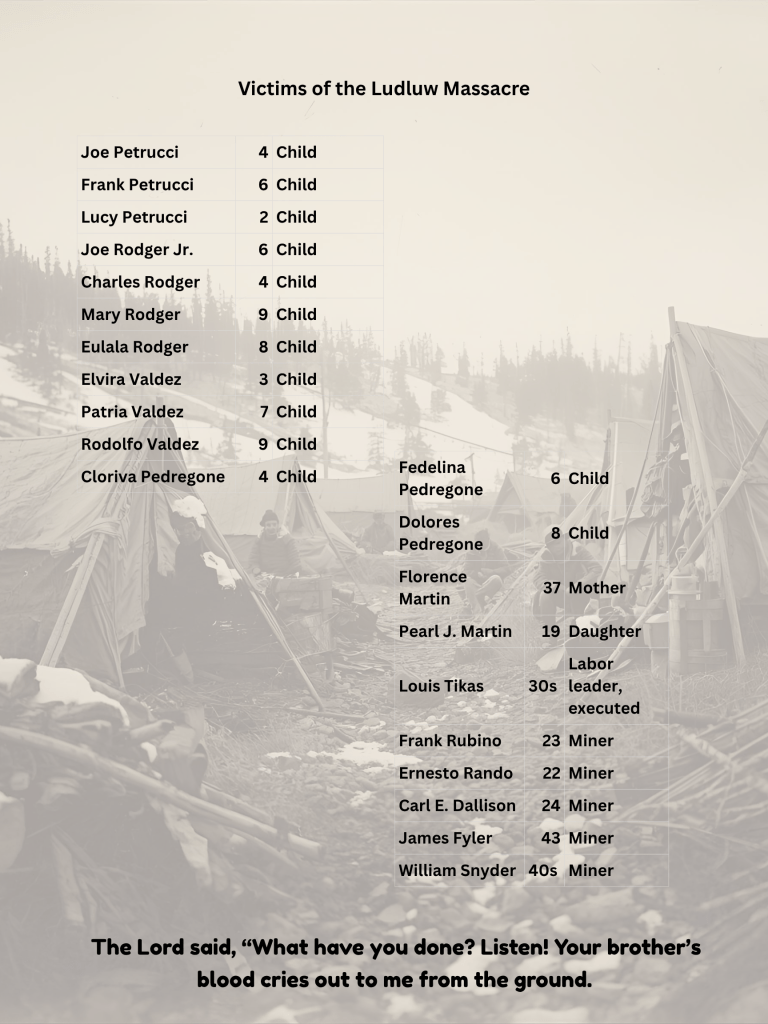
The violence that unfolded that day was not an isolated incident, but rather the culmination of months of tension between striking coal miners and the industrial powers that sought to break them. In 1913, thousands of miners—many of them immigrants—walked off the job in protest of brutal working conditions under the Colorado Fuel & Iron Company, owned by John D. Rockefeller Jr. Evicted from company housing, they built tent colonies on leased land, forming a resilient, self-governed community in Ludlow. These weren’t agitators; they were families, workers, and organizers seeking dignity and fair wages.
But the state’s response was not neutral. The Colorado National Guard, funded in part by the mine owners themselves, was deployed. On April 20, 1914, peace shattered. Machine guns were mounted on the hills above the camp. Gunfire strafed the tents. As miners fled or fought back, women and children hid in cellars dug beneath the canvas shelters. Then came the fire. Guardsmen soaked the tents in kerosene and set them ablaze. In one cellar, eleven children and two women suffocated and burned to death. In total, twenty-five people were killed—including labor leader Louis Tikas, reportedly lured out under false pretenses and executed.
Can a Nation Keep a Standing Army?
The Ludlow Massacre was not an isolated tragedy, it was a flashpoint in a long and troubling history of domestic military intervention against U.S. citizens. At its core lies a constitutional tension: when, if ever, should the federal or state government deploy military force within its own borders?
The U.S. Constitution grants Congress the power to “raise and support armies” (Article I, Section 8), but it also enshrines protections against standing armies and unchecked executive force. The Founders, shaped by British abuses, feared the use of military power to suppress dissent. That fear birthed the Posse Comitatus Act of 1878, which prohibits the use of federal troops to enforce domestic laws without explicit Congressional authorization.
Yet history shows how easily that line can blur.
In Ludlow, the Colorado National Guard was deployed, allegedly to maintain peace. But their actions aligned more with corporate interests than constitutional restraint. The Guard’s use of machine guns, arson, and lethal force against civilians—including women and children—raises profound legal and moral questions. Who authorized the violence? Who was held accountable? And what does it mean when the state becomes the enforcer of private power?
This pattern has echoed through other moments in U.S. history: the Bonus Army eviction in 1932, the Kent State shootings in 1970, and the federal deployment in Portland in 2020. Each instance reveals the fragility of constitutional safeguards when fear, profit, or political expediency override principle.
For Christians, this isn’t just a legal issue; it’s a spiritual one. What is our responsibility when the state, as God’s servant, inflicts wrath upon its own peaceful citizens?
What of Insurrection?
The Insurrection Act of 1807 was crafted as a narrow exception to the Posse Comitatus Act, allowing the president to deploy military forces domestically only in extreme circumstances, such as rebellion, insurrection, or when state governments fail to uphold constitutional rights. Historically, it’s been invoked to suppress the Ku Klux Klan during Reconstruction and to enforce desegregation in the Civil Rights era. But its vague language and lack of modern safeguards make it vulnerable to abuse, especially when political leaders conflate civil unrest with warfare.
That danger came into sharp focus when President Trump, speaking to hundreds of military leaders at Marine Corps Base Quantico, suggested using major U.S. cities as “training grounds” for the military. He described cities like Chicago, Portland, and Los Angeles as “war zones” and declared a “war from within,” framing domestic unrest and political opposition as military targets. The rhetoric wasn’t just provocative, it was constitutionally reckless.
Legal scholars and governors swiftly condemned the remarks, warning that such deployments would violate the spirit of the Posse Comitatus Act and dangerously stretch the Insurrection Act beyond its intended limits. The notion that American neighborhoods could be used as live-fire rehearsal spaces for federal troops is not only illegal but also morally repugnant. It echoes the very abuses the Founders sought to prevent when they warned against standing armies and unchecked executive power.
The Way of Liberty and Faith
For citizens, the issue isn’t just constitutional. The Insurrection Act, once a tool of last resort, now hangs like a sword over every moment of civil unrest. When presidents speak of deploying troops to “war zones” within our own borders, they’re not preserving liberty. The idea that American cities could be used as “training grounds” for military exercises is not only grotesque—it’s a betrayal of the very principles this republic was founded on.
Liberty demands vigilance. It demands that we reject the normalization of domestic militarization, no matter how polished the rhetoric or how urgent the crisis. The Founders warned against standing armies for a reason: because power, once centralized and armed, rarely retreats without resistance.
This thought is not to incite rebellion, but to awaken resolve. The Church and citizens are called to exercise discernment, dignity, and principled defiance.
What is the Limit of Romans 13
This issue is not partisan; it is principled and built on the ideas of our nation’s founding. At this moment, principle demands that we ask: Are we being lulled into accepting militarized control as “normal”? When presidents speak of cities as “war zones,” and troops are deployed against peaceful citizens, the Church must not mistake force for righteousness.
Revival in a culture of fear begins with discernment. It begins when believers recognize that “law and order” rhetoric, stripped of justice and mercy, becomes a mask for a deeper erosion of liberty. It begins when we refuse to baptize state violence simply because it wears a uniform or waves a flag.
Romans 13 tells us that the governing authorities are “servants of God,” ordained to punish evil and reward good. However, when the wrath meant for evildoers is unleashed on peaceful citizens, the Church must not remain silent. Our responsibility is not blind submission, but rather faithful witness.
Scripture provides us with precedent. When King Saul abused his power, the prophet Samuel rebuked him. When Herod slaughtered innocents, the early Church did not call it justice; they called it evil. When Jesus stood before Pilate, He did not affirm Rome’s authority; He exposed its cowardice.
Acts 5:29 Calls Us to a Greater Voice
So what is our responsibility?
To speak truth to power—not with rage, but with resolve.
To defend the oppressed—not with slogans, but with sacrifice.
Discern the times with faith, not fear.
The Church must refuse to be chaplain to the empire and instead become a voice in the wilderness. Render & Resist will not bless the sword when it turns inward. We will name it. We will mourn it. And we will call the people of God to stand.


Leave a comment