

When Headlines Preach False Certainty
Recently, Health and Human Services Secretary Robert F. Kennedy Jr., alongside President Trump, made headlines by strongly claiming that Tylenol use during pregnancy may be a leading cause of autism in children. The announcement, delivered at a press conference and amplified across media platforms, urged pregnant women to “fight like hell not to take it” and warned of a “very increased risk of autism” tied to acetaminophen use.
Behind the urgency and conviction was a troubling reality: the claim (using acetaminophen during pregnancy may cause autism) bypassed peer-reviewed consensus, misrepresented the nature of the evidence, and conflated correlation with causation.
In contrast, large-scale studies from Sweden and Japan have tested the same hypothesis using sibling controls and long-term cohort data. These studies found no causal relationship between acetaminophen use and autism, and emphasized the importance of controlling for maternal health conditions and genetic factors.

This Primer was born out of moments like these, when headlines preach certainty, but the data whispers caution. As Christians, we are called to test all things (1 Thess. 5:21), to seek wisdom (James 1:5), and to resist the temptation to outsource discernment to media, institutions, or political figures. Scientific claims, especially those that shape public health and personal decisions, must be evaluated with humility, clarity, and conviction.
Section 1: Case Study Breakdown — Tylenol & Autism
The claim was based on a 2025 Harvard meta-analysis led by Andrea Baccarelli, which reviewed 46 observational studies and found that 27 showed a statistical association between prenatal acetaminophen exposure and neurodevelopmental disorders such as autism and ADHD. But the study’s findings were correlational, not causal, and the lead researcher had previously served as an expert witness in lawsuits against Tylenol’s manufacturer, raising serious concerns about impartiality and sponsor bias.
- Type of Evidence: Meta-analysis of observational studies
- Finding: Correlation between acetaminophen use and autism diagnoses
- Limitations:• No causal mechanism established
- Confounding by indication likely (e.g., fever or infection may be the true risk factor)
- Lead researcher’s legal involvement introduces potential bias
This is a textbook example of how surface-level strength—Harvard branding, statistical rigor, and media amplification—can mask deeper flaws. The claim derived from the study that acetaminophen causes autism the announcement misrepresented its correlational nature, and its conclusions were cherry- picked and quickly politicized.
- Sample: 2.4 million children born between 1995 and 2019
- Method: Sibling comparison design to control for genetics and environment
- Finding: No causal link between prenatal acetaminophen use and autism
- Strength: Long-term cohort data with robust controls
- Focus: Controlled for maternal health conditions and medication indications adjusting for bias
- Finding: No evidence of causation
- Strength: Direct outcomes measured, confounders addressed
These studies demonstrate the power of long-term cohort data: tracking families over time, controlling for variables, and testing causation rather than assuming it. They stand in stark contrast to the Harvard study’s limitations and the political urgency with which its findings were weaponized.

Section 2: Visual Analysis — “Studies Look Legit… But Are They?”

At first glance, the Harvard Tylenol study appears authoritative: it’s backed by a prestigious institution, cites dozens of observational studies, and presents its findings with statistical precision. But surface strength is not the same as scientific integrity. Beneath the veneer of credibility, the study exhibits several red flags that demand discernment. It relies on correlational data, not causal evidence. It aggregates studies with varying quality and inconsistent controls. Notably as mentioned above, the lead author may be biased. A detail that introduces sponsor bias and undermines neutrality.
The study also leans heavily on surrogate endpoints: indirect measures like behavioral markers or diagnostic trends rather than direct biological mechanisms. This is a common tactic in politicized science: substitute what’s measurable for what’s meaningful. Without controlling for confounding variables such as maternal health, infection, or socioeconomic status, the association between acetaminophen and autism becomes speculative at best. In this light, the Harvard study fits a familiar pattern, one where prestige, urgency, and legal entanglements obscure the deeper methodological flaws. It’s not just a weak foundation—it’s a cautionary tale.
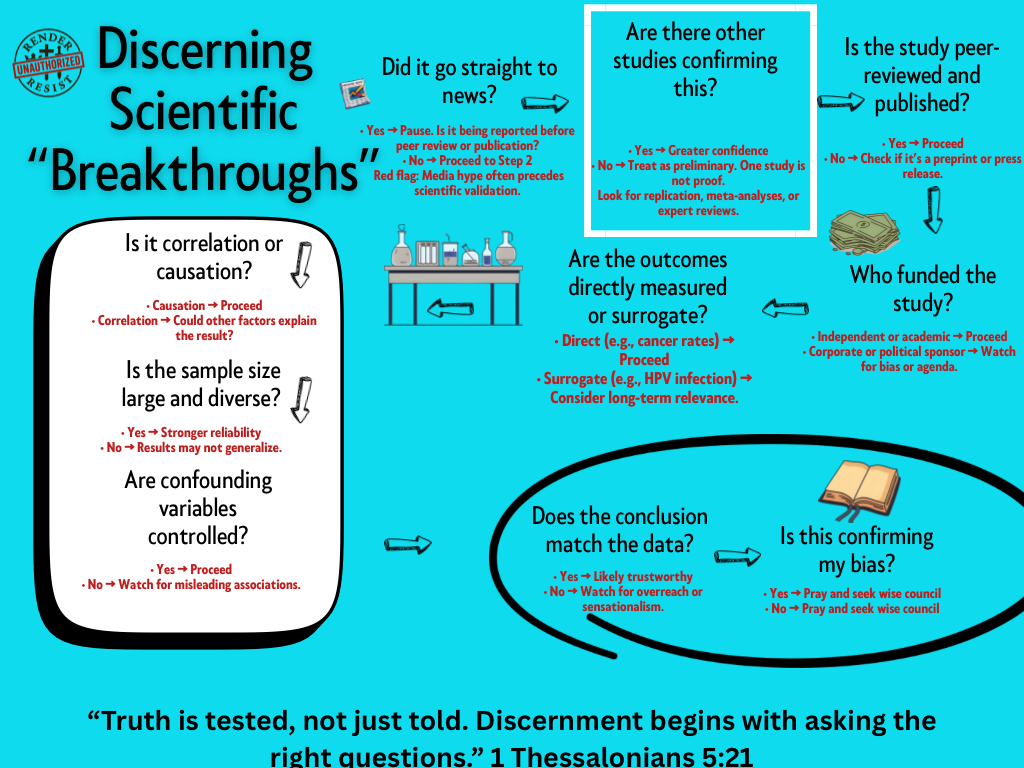
Section 3: Flowchart — “Should I Trust This Scientific Breakthrough?”

Imagine you’re scrolling headlines and see a bold claim: “New Study Links Common Drug to Autism.” Before panic sets in or opinions harden, pause—and walk the path of discernment.
Step 1: Did it go straight to the news?
If the study is being broadcast before peer review, that’s a red flag. Media hype often outruns scientific scrutiny. Sensationalism sells, but truth waits for testing.
Step 2: Are there other studies confirming this?
One study is a spark, not a fire. Look for replication, especially from independent teams. If other studies—like those from Sweden or Japan—find no causal link, proceed with caution.
Step 3: Is the study peer-reviewed and published?
Preprints and press releases are not proof. Peer review is the first firewall against error and bias.
Step 4: Who funded the study?
Follow the money. If the researcher is tied to lawsuits or corporate interests, the findings may be shaped by agenda more than evidence.
Step 5: Is it correlation or causation?
This is the heart of the matter. Just because two things occur together doesn’t mean one causes the other. The Harvard Tylenol study showed correlation—but the Swedish and Japanese studies tested for causation and found none.
Step 6: Are confounding variables controlled?
Did the study account for maternal health, genetics, or socioeconomic status? If not, the results may be skewed by unseen factors.
Step 7: Are the outcomes direct or surrogate?
Is the study measuring what truly matters (e.g., autism diagnosis), or using a proxy (e.g., inflammation markers)? Surrogates can mislead.
Step 8: Does the conclusion match the data?
Sometimes the headline overstates the findings. Read the fine print. Does the data support the claim—or just suggest a possibility?
Final Step: Is this confirming my bias?
This is where spiritual discernment enters. If the claim aligns perfectly with your fears or beliefs, pause. Pray. Seek wise counsel. Truth doesn’t flatter—it refines.
Section 4: Discernment as a Spiritual Discipline
For Christians scientific discernment is spiritual. Scripture calls us to “test all things; hold fast what is good” (1 Thess. 5:21), a command that applies as much to “media” headlines as it does to moral teaching. In a world flooded with data, studies, and expert opinions, the believer must cultivate a posture of wisdom. One that neither blindly accepts nor reflexively rejects new information based on previous biases. James reminds us that wisdom is a gift from God, given generously to those who ask without doubting (James 1:5). That means discernment begins with humility before the Lord.
This humility guards us against partiality, especially the kind that masquerades as conviction. James 2 warns against favoritism, whether toward the rich, the powerful, or the familiar. In scientific discourse, partiality often shows up as bias confirmation: accepting claims that reinforce our fears, politics, or worldview without testing them. True discernment requires us to ask, “Am I believing this because it’s true—or because it’s convenient?” This posture protects the heart from deception and the church from manipulation.
Prayer and wise counsel are essential companions on this path. No flowchart or checklist can replace the Spirit’s guidance or the wisdom of wise counsel. When a claim feels urgent, emotional, or politically charged, that’s the moment to pause. To pray. To seek clarity. To ask not just “Is this study sound?” but “Is my heart sound?” because discernment is about walking in truth, resisting fear, and honoring the God who calls us to love Him with all of our heart, mind, and soul.
Section 5: Liberty & Reason — A Warning Against Politicized Science
Discernment doesn’t end with data; it extends to the systems that claim authority over it. For decades, institutions like the NIH have positioned themselves as arbiters of health, issuing guidance that often shifts with political winds. From dietary mandates to pharmaceutical endorsements, their track record reveals a troubling pattern: science subordinated to bureaucracy. As Murray Rothbard warned, “The State is not us. It is not the human family writ large. It is a coercive criminal gang.” When government agencies claim the right to advise—or worse, to mandate—personal health decisions, they overstep their bounds, infringing on the territory of conscience, community, and covenant.
The problem isn’t just flawed advice, it’s the erosion of reason itself. Political incentives distort scientific inquiry, rewarding consensus over curiosity and compliance over critique. To put it plainly, as Rothbard did: “What the State says is law, and what the State does is legal.” But legality is not morality, and consensus is not truth. Christians must resist the temptation to outsource discernment to centralized power. Health is not a public utility, but rather a personal responsibility. When politics leaks into science, reason drowns. Liberty demands vigilance.
This Primer is not a call to rebellion; it’s a call to responsibility. To test claims, not just accept them. To seek wisdom. And to remember that the Spirit of truth does not dwell in institutions, but in the hearts of those who fear God and walk humbly with Him. Render unto Caesar what is Caesar’s—but do not render your reason.
Conclusion & Call to Action
Scientific discernment isn’t a luxury. It’s a Christian responsibility. In an era where headlines often proclaim certainty and institutions blur the line between data and dogma, believers need to be equipped to scrutinize every claim, critically examine every study, and protect their minds with truth. This Primer offers a starting point: info-graphics, a flowchart, and a case study that expose how even prestigious research can mislead when politics, bias, or surrogate endpoints distort the picture.
You’re welcome to download and share the visuals, along with a bonus set of AI prompts to speed up your search for answers. Use them in your church, your homeschool group, your blog, or your next conversation with someone wrestling through the noise.
And now, a question for you: What breakthrough headlines have you wrestled with lately? What claims felt urgent, persuasive, or unsettling? Let’s talk. Let’s test. Let’s resist the fog—and render clarity.





Leave a comment